The Katoikos
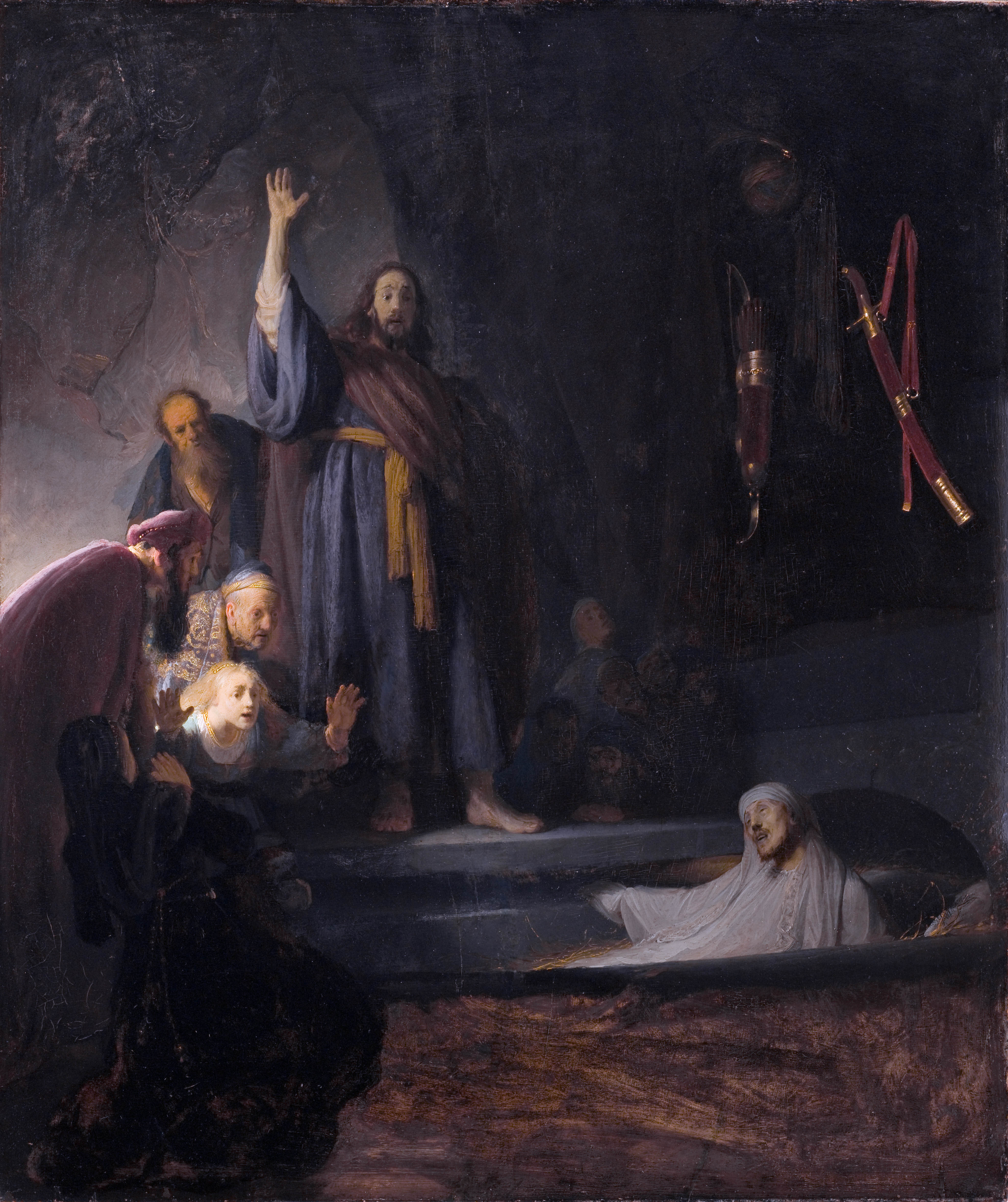 The dead answering a call they should no longer be able to hear — continuation past the point where continuation should have stopped. The Raising of Lazarus, Rembrandt van Rijn, c. 1630–1632. Los Angeles County Museum of Art (M.72.67.2). Public domain.
Κάτοικος: “dweller,” “inhabitant,” “one who settles in.” In the context of Hecate’s sphere: dweller-below, one who has made residence on the wrong side of an ending.
Also called: the Restless, the Persistent, the Dweller. Common parlance: Revenant, Zombie, the Dead-Who-Aren’t, Corpse-walker.
The Ending threshold is exactly what it says it is.
You crossed the moment that should have been your last. Not survived it, many people survive near-death, and it changes them, and they are still people with a future that continues forward from where they were. You crossed the Ending. The ending was real. What came after is something else, operating under different terms, in a body that should not still be operational.
What you said yes to was continuation; continuation after the point at which continuation should have stopped. What the bargain gave you was the capacity to persist, to be hard to end, to carry the weight of what you were into what you have become. What the geas gave you was the ending’s ongoing claim: the structural reminder that you are operating on borrowed terms, and the moment that took you has not forgotten its debt.
You are not simply hard to kill. Many people are hard to kill; that is a quality of constitution or luck or skill. You are something more specific: a person for whom the ending already happened, and who is here anyway. The dead who are not done. The ones for whom the terms of existence have been renegotiated, on terms that favour continuation.
Other traditions call this haunting, or undeath, or the persistence of spirits. The Sanctuary calls it the Katoikos because the word names what you actually are: a settler, a dweller, someone who has taken up residence somewhere they were supposed to merely pass through. The ending was the door. You moved in.
Background Options
- The ending came violently and without warning, and your refusal was immediate and unconsidered. You are still working out what, exactly, you refused, and why.
- You were offered a choice while in the process of dying. The other option was worse. You have thought about that other option many times since.
- You were not the only one. Others crossed the same threshold the same night, in the same place. You are the only one still here. You do not fully understand why.
- The ending took someone close to you first, and you followed: trying to find them, trying to fix it, trying to get there in time. You crossed on the way back. They did not.
- Someone else’s bargain kept you here. You did not choose this. The person who chose it is gone and you remain, operating under the terms of a deal you did not make.
- You have been Katoikos for longer than most people know. The early years were difficult. You have, in some important senses, adapted. Other things have not adapted around you.
- The ending was quiet and entirely undramatic: an illness, a failure of the body, a gradual stopping. And then you were back, and things were different. You never expected this to happen to you.
Katoikos Abilities
You gain all of the following benefits:
- Able to take three more minor wounds and one more moderate wound
- Add +3 to Might Pool
- Add +1 to Speed Pool
- Add +1 Edge in Pool of your choice (Might recommended)
- Freely use light and medium weapons
- Freely use light armor
- At tier 3 and tier 6, choose an ability from the Sanctuary Genre Abilities list
Sense the Departed: You perceive the presence of lingering dead, restless spirits, and the residue of endings within short range. You automatically know if a space has been the site of a recent death, if spirits are present and roughly how many. You gain an asset on tasks to communicate with, locate, or understand the restless dead. Enabler.
Deathly Bearing: Those perceptive enough to sense what you are feel something wrong; not threatening, exactly, but fundamentally off. You gain an asset on tasks to intimidate, unsettle, or establish that you are not to be trifled with. Creatures with supernatural sensitivity (including some animals) tend to register your presence before others in your group. At tier 3, you can turn this off: for the duration of a scene, you pass as entirely ordinary to supernatural senses. Enabler.
The Weight Carries On (1 Might): When you take your final major wound, the one that would kill an ordinary person, you may immediately activate this ability as a free action. Make a difficulty 3 Might defense roll. On a success, that wound’s severity is reduced by one step: the killing wound becomes a third major wound that has not yet killed you. You may only attempt this once per scene. At tier 3, the difficulty drops to 2. Enabler.
Katoikos Equipment Bundle
Something warm (the cold is a constant now, and you manage it), clothing appropriate to wherever you came from before the ending, an object that connects you to your life before (the specific object is yours to define; the Sanctuary simply notes that Katoikos tend to carry one without being asked), and currency enough to operate in the present, since the present is apparently where you live.
Or assemble your own: appropriate clothing, one expensive item, five moderately priced items, six inexpensive items, and currency equivalent to a moderately priced item.
The Geas: The Ending’s Claim
The ending was real. It has not forgotten. The Geas tracks how strongly it reasserts itself.
Trigger: The Geas advances by 1 state when you use The Weight Carries On, spend an extended period without rest, are present at or near significant death (battlefields, violent mass events, places of accumulated dying), or push yourself past the point where a living body would stop.
State 0 — Settled: The Katoikos presents as largely ordinary; perhaps a little cold, a little too still, a little too pale. No penalties.
State 1 — Stirring: The signs become more visible. The Katoikos’s appearance shifts in ways that are difficult to articulate but noticeable to perceptive observers. Social tasks with people who can sense the supernatural are hindered. The Katoikos finds themselves drawn toward places where the dead linger.
State 2 — Rising: The ending is reasserting itself. The Katoikos’s Might Pool regenerates 1 additional point per recovery; the death-state brings its own resource. However, tasks involving warmth, intimacy, or sustained emotional connection with the living are hindered: the distance between states is becoming legible.
State 3 — Breaking: The ending has its logic, and for one scene, that logic is in control. The Katoikos is driven by the compulsion of the dead: finding what was left unfinished, seeking people who need to be spoken to, performing whatever their specific Ending demands of them. During this scene, they are immune to fear effects. Their Might Pool recovers fully (once). Their actions follow the compulsion, not their own agenda. When the scene ends, the Geas returns to State 2.
Relief: Rest. Genuine, embodied rest. Sleep if they sleep, deliberate stillness if they don’t. The Katoikos must stop completely for a significant period, and in that stopping, acknowledge clearly that the ending was real: they died, or should have died, and they are here anyway, and the ending has not been cancelled, only deferred. The acknowledgment must be genuine. The Geas does not accept denial. Drops the Geas by 1 state.
Cypher Manifestation Styling
Katoikos styling for Cypher Manifestation will be detailed in the Sanctuary Manifestation Guide. Provisional: styling expresses as death-adjacent, residual, and persistent. Effects tend to endure past their natural end. Things that should stop, continue.
See also: The Axiomata, Character Foci, Character Types