“Do not imagine that the world you stand in is the world. It is a room in a house in a city on a continent of a world you cannot see from where you are. And the house has more rooms than you have numbers for.” — attributed to the Librarian; source unknown
The Pleroma
The Pleroma (from the Greek πλήρωμα, “the Fullness”) is the name given to the totality of all existence: every plane, brane, dimension, timeline, and interstitial space that has ever been, is, or might yet become. It is not a place within which these things exist. It is the sum of them: the Fullness, complete and infinite.
Most beings who know of it do not have a name for it at all. They know only their own corner of it: their world, their laws of nature, their understanding of the divine. The name “Pleroma” belongs to a particular tradition of knowing, and should not be mistaken for a fact about reality. It is a useful fiction, like all maps.
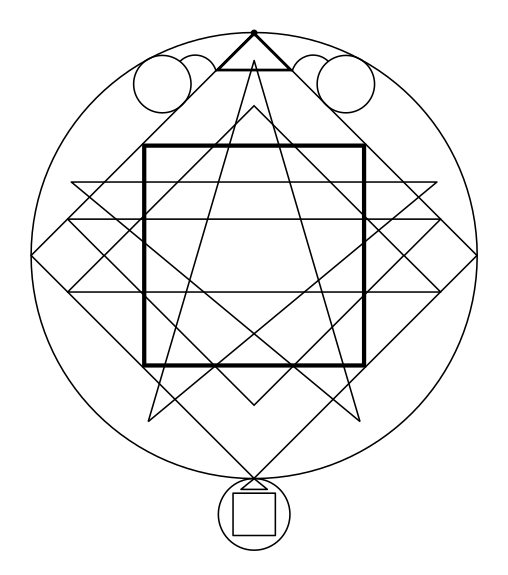
The Cosmological Boundaries: Apeiron, Peras, and Arche
At the farthest reaches of the Pleroma, beyond any plane that contains or could contain life, stand the ultimate cosmological boundaries. They are not gods or forces with agency; rather, they are the foundational principles of existence.
Apeiron
The Infinite. The Wellspring. Genesis. Chaos. The Primordial Ocean. Apeiron (ἄπειρον, “the Boundless”) represents the infinite, undifferentiated substrate of raw existential energy, chaos, and continuous motion. It is pure potential: where Apeiron is absolute, there is no structure, no boundary, no memory, and no sequence. All energy originates in Apeiron. All magic is a drawing upon it—a temporary reaching into the boundless and pulling something across the threshold into form.
Peras
The Singularity. The Foundation. Terminus. Order. Law.
 Peras (translating directly to “Limit”) is the absolute counterpart to Apeiron, replacing previous flawed understandings that conflated this extreme with Arche. Peras is the formal, active principle of the cosmos, associated with unity, rest, and numerical oddness. The material universe is generated by the active imposition of Peras (Limit) upon the chaotic, infinite expansion of the Apeiron. Where Peras is absolute, time does not pass and change is impossible, for it is the ultimate organizing mathematical and structural parameter that gives rhythm and shape to reality.
Arche
The Point of Origin. The Sovereign Ruler. Arche (ἀρχή, “the Origin” or “the Principle”) originally translates to “beginning” or “origin,” and rather than acting as a limitless extreme, it reflects a fixed point in the Pleroma. The Arche is the definite, sovereign point of origin and the supreme, unmanifest conscious potential standing above all creation. It provides a stable, rational governing principle that prevents the universe from dissolving into an incomprehensible, boundless void.
The Two Absolutes
At the farthest reaches of the Pleroma, beyond any plane that contains or could contain life, stand the two Absolutes. They are not gods. They are not forces in any sense that implies agency or will. They are the conditions within which everything else is possible.
The Vertical Path: Katabasis and Anabasis
Within this cosmological framework, the movement of souls through the inhabited planes of the Pleroma is governed by two opposing directional movements:
Katabasis (The Descent):
This is the downward journey and the process of incarnation into the physical body. As the soul descends into the material world, it falls through the planetary spheres, absorbing their specific characteristics, limitations, and vices. Katabasis is the mythological and magical framework for the soul’s fragmentation, materialization, and division from the divine.
Anabasis (The Ascent)
The exact opposite is anabasis (or anagoge), the path of upward return. This is the theurgical mechanism for reversing the fall and shedding the weight of the cosmos. It requires the adept to conceptually and ritually ascend through the planetary spheres in reverse order, systematically shedding material vices. The ultimate goal of this ascent is the divinisation of the adept (theia mania) and a return to the transcendent origin of the Arche.
The Inhabited Planes
Between the two extremes of Apeiron and Peras lies the habitable gradient of the Pleroma. The nature of physical law on any given plane depends on its proximity to these boundaries. Planes near Peras are matter-dense, rigid, and governed by universal physics. Planes near Apeiron are wild with magic, unstable, and experience time in looping or branching superpositions.
![[cellarius-ptolemaic-system.jpg|Andreas Cellarius, Harmonia Macrocosmica (1660): the Ptolemaic cosmos, with the Earth at centre and the inhabited spheres arranged in zones radiating outward. Public domain.]]
This is not design. There is no designer. It is simply that beings capable of perception, memory, purpose, and succession require conditions that only arise in the middle distance. They are too fragile for Apeiron’s endless unmaking; they are too dynamic for Arche’s eternal freeze. They are creatures of the threshold.
The planes within this zone differ enormously from one another. Some are closer to Apeiron: wild with magic, unstable in their physical laws, populated by beings who reshape themselves as readily as they reshape the world. Some are closer to Arche: matter-dense, magic-lean, governed by physics so reliable that their inhabitants often do not believe in magic at all. Many exist in conditions broadly similar to our own; neither extreme is dominant, and the struggle between change and permanence is conducted in every corner of every life, every day.
There is no clear boundary to the habitable zone. It fades at both edges. At the Apeiron edge, planes become increasingly strange and increasingly inhabited by things that cannot be called “life” in any familiar sense: pure processes, living ideas, forms that last only as long as they are observed. At the Arche edge, planes become increasingly rigid, their magic increasingly thin, their histories increasingly fixed, their inhabitants increasingly crystallised into the patterns they have always inhabited.
The Spectrum and Its Implications
The position of a plane along the Apeiron-Arche spectrum, sometimes called the Resonance by those who think about such things, shapes almost everything about it.
The flow of magic in any given plane is a function of how much Apeiron-energy can reach it. A plane near the Apeiron extreme is saturated with it; reality bends constantly, and what is called “magic” is simply the default condition of things. A plane near the Arche extreme may have no magic accessible at all, or magic so attenuated as to be indistinguishable from very precise and unlikely coincidence. Most inhabited planes fall somewhere in the middle: magic exists, it can be worked, but it requires knowledge, will, and cost.
The nature of physical law is similarly shaped by Arche’s influence. In planes near Arche, the laws of nature are consistent, universal, and essentially unbreakable. In planes near Apeiron, what are called “laws” are more properly called “tendencies”: patterns that hold most of the time, in most places, but that yield to sufficiently strong intention, ritual, or pressure.
The experience of time shifts as well. Near Arche, time is linear, reliable, and unidirectional. Near Apeiron, time may loop, branch, pool in eddies, or run in multiple directions simultaneously. Some planes near the Apeiron edge contain all of their possible timelines in a kind of superposition, and travellers who enter them may find themselves shifting between histories without warning.
The Sanctuary’s Place in All This
The Sanctuary of Hecate, and by extension the broader domain over which Hecate presides as a principle, occupies an unusual position within the inhabited zone. Liminal spaces, by definition, resist easy placement on the Apeiron-Arche spectrum. They exist at thresholds: at the edge of categories rather than within them.
This is why the Sanctuary’s geography is impossible. Why its rooms do not always connect in expected directions. Why time inside it does not always match time outside it. These are not malfunctions. They are signs of a space that is genuinely between: not merely between locations, but between conditions of existence.
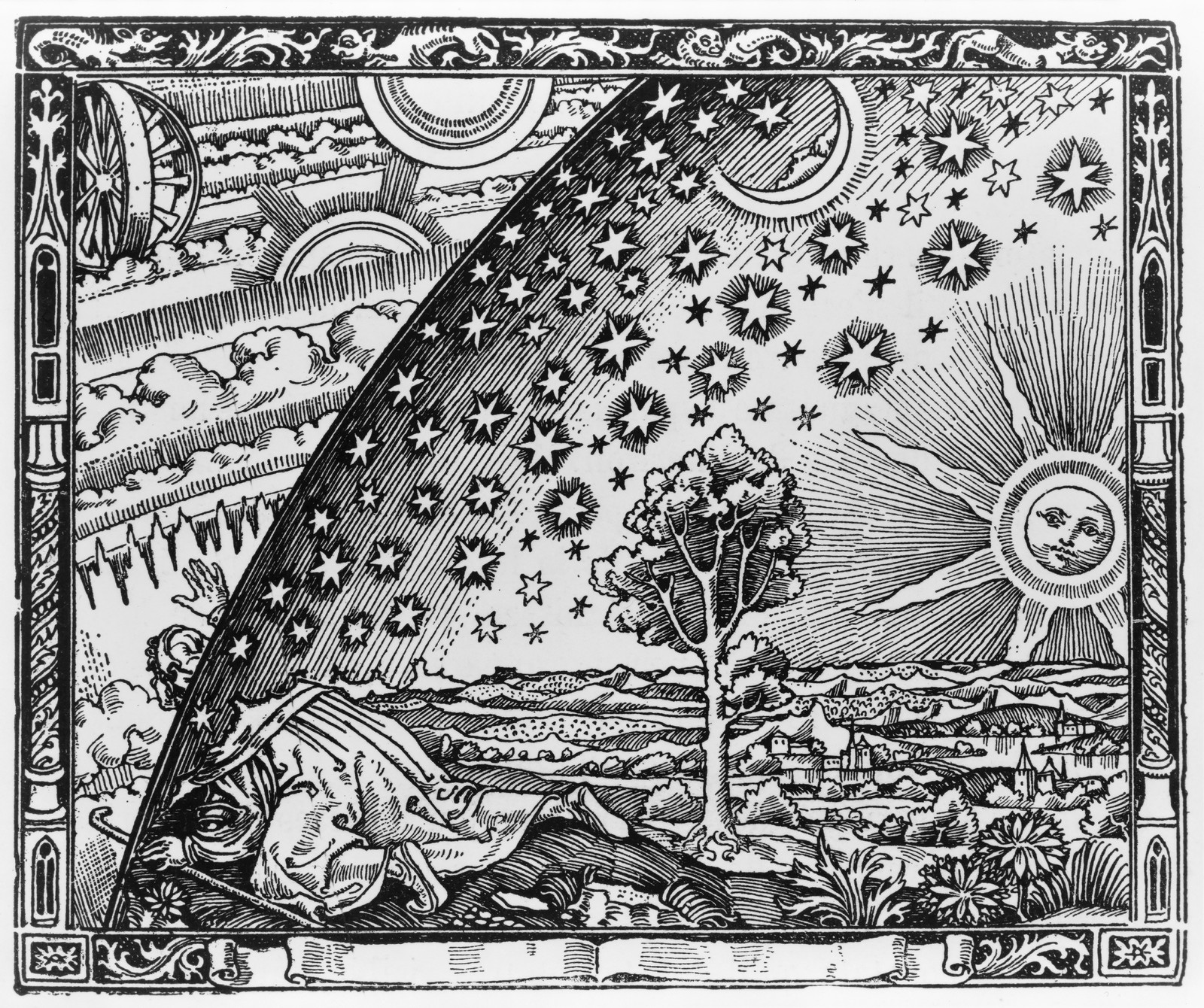
The Sanctuary is a room in the threshold between what is and what might be. That is its nature. That is its power. And that is, in the long run, why it draws the people it draws: the Marked, the Accursed, the ones who have already crossed some threshold of their own and found themselves no longer entirely of the world they left.
A Note on Knowing
None of what is written above should be taken as established fact within the campaign. The Pleroma as described here is a cosmological model, one framework among many for understanding why the world is the way it is. Within the setting, very few beings have access to anything like a complete picture of the Pleroma’s structure. Those who have glimpsed parts of it tend to describe those parts in terms borrowed from whatever tradition they came from.
A scholar of alchemy calls Apeiron prima materia and Arche the philosopher’s stone at the heart of God. A chaos mage calls them the Wyld and the Pattern. A physicist who has seen too much might call them entropy and negentropy, vacuum energy and crystalline symmetry. A Marked resident of the Sanctuary calls them, if they call them anything, “the deep noise” and “the long quiet.”
All of these names are true. None of them are complete. The Pleroma does not care what you call it. It was there before naming, and it will be there after.
Status: Published — background lore; not for immediate campaign use. To be developed as the World Bible expands.
Inspirations: Michael Moorcock (Eternal Champion cycle); pre-Socratic philosophy (Anaximander’s ἄπειρον; Anaximenes’ ἀρχή); Gnostic cosmology (Pleroma as the Fullness of divine being); M-theory / brane cosmology (planes as membranes in higher-dimensional space).
See Also
- The Axiomata — the Sanctuary’s foundational truths about magic, the Marked, the Choice, and the Geas
- The Sanctuary of Hecate — the House itself, and its place as a liminal constant within Hekate’s sphere
- Hecate — the principle whose domain encompasses the Sanctuary and all things liminal
- Magic and Mysticism — the historical and ritual grounding of Hekate’s role as cosmic mediatrix