Magic and Mysticism
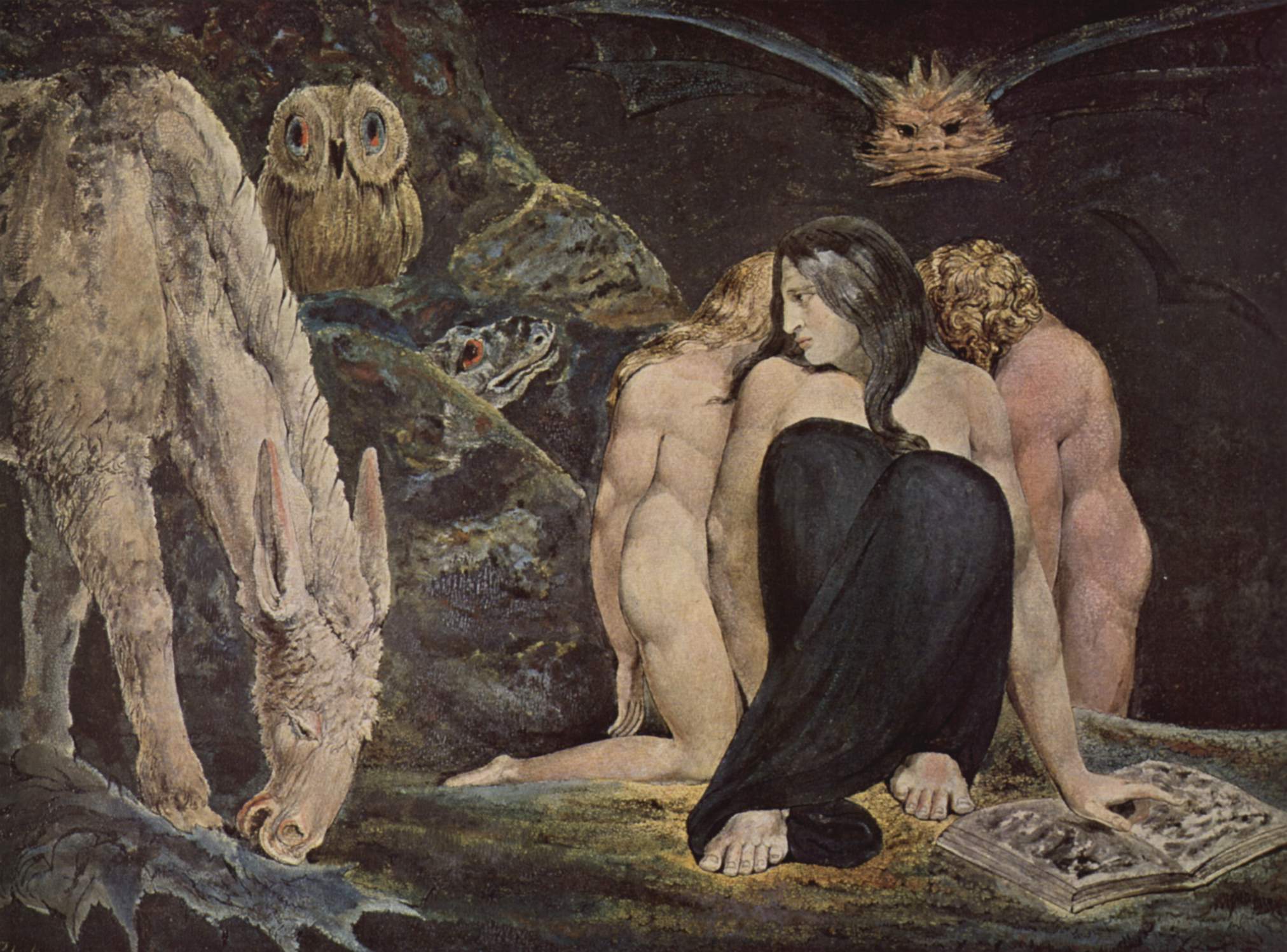 William Blake, The Night of Enitharmon’s Joy (1795), traditionally and persistently called Hecate , the most famous Romantic-era depiction of the goddess. Tate Britain. (Wikimedia Commons, public domain.)

Research Hub · Mythological Narratives · Epithets · Cross-Cultural Parallels · Campaign Hooks
The Hecate of the schoolroom (witch-queen, crossroads goddess, moon-lantern carrier) is a composite built from three very different traditions. First, the ordinary civic and domestic cult of archaic and classical Greece, centred on the monthly supper at the crossroads and the threshold shrine. Second, the operative magic preserved in the Greek Magical Papyri and in thousands of surviving curse tablets, where Hecate is addressed as executrix of the practitioner’s will. Third, the contemplative mysticism of the Chaldean Oracles and Neoplatonic theurgy, in which Hecate becomes a cosmic principle of mediation and the ladder by which souls return to the divine. Each tradition reinforces the others; all three flow together by Late Antiquity.
The Deipnon
The Deipnon (Δεῖπνον, “supper”) was the best-attested regular rite of Hecate in the Greek-speaking world. It was held every month on the final day of the lunar month, the night of the dark moon, called by Athenians Hene kai Nea (“old and new”), the hinge between the moon that has died and the moon that has not yet been reborn. It lasted from roughly 2,500 years of documented practice, surviving into Late Antiquity and, some practitioners argue, beyond.
A meal was prepared at home and carried out after dark to a small shrine at the front door, typically a Hekataion, the triple-bodied statuette, or to the nearest three-way crossroads. The threshold of the house itself was treated as a crossroads because the street outside met the doorway inside. The food was left for Hecate and for her train: the apotropaioi, the restless dead, and those who had died badly and not been properly buried.
Primary sources (Aristophanes, Plutarch, Demosthenes) mention the following among the offerings:
- magides: small loaves or cakes, often moon-shaped.
- raw eggs.
- fish (often red mullet, her sacred fish).
- garlic, leeks, and onions, all of the strong-smelling vegetables; these are still used in modern Hecatean practice as purifiers.
- the household’s sweepings: literal dust and floor-sweepings, understood as symbolically the household’s accumulated pollution being returned to Hecate for disposal.
Two procedural rules were universal. The offerer, having placed the meal, must not look back as they returned home, the same injunction Apollonius gives Jason. And the offering, once given, must not be eaten by any member of the household. It belongs entirely to the goddess and her train. The one exception, widely noted and sometimes mocked, was that the poor would come by night and eat the offerings; Aristophanes’s Plutus makes a joke of it. Modern practitioners often read this as a feature: the Deipnon was a monthly system for channelling surplus food from prosperous households to the hungry under divine cover, and Hecate’s aspect as Kourotrophos (nurturer of the young and weak) implicitly underwrote it.
The Deipnon was immediately followed, on the first of the new lunar month, by the Noumenia, a festival of the new moon honouring Apollo Noumenios, Selene, Hestia, and the household gods. Together the two observances formed the hinge of the Athenian month: the Deipnon purged the old, the Noumenia inaugurated the new.
Threshold Cult
Beyond the Deipnon, everyday Hecate worship was domestic. Small triple-bodied statuettes called Hekataia or hekataion stood in front of private houses, frequently at the door or in the courtyard. These were analogous to the herm pillars associated with Hermes; in fact Hecate and Hermes were often paired as threshold deities, and some sources treat them as consorts. The functions overlap: both guide travellers, both conduct souls, both receive offerings at the boundary. But where Hermes was the psychopomp of the male hero, Hecate was increasingly the psychopomp of the woman in childbed and the unburied dead.
Her Athenian cult title Propylaia (“before the gate”) appears in inscriptions at the Acropolis; a small shrine of Hecate Propylaia stood at the western entrance. City gates throughout the Greek world received similar shrines.
The Greek Magical Papyri
The Papyri Graecae Magicae (PGM) are a corpus of magical manuals written on papyrus in Greek, Demotic, and Coptic, produced in Graeco-Roman Egypt roughly between the 100s BCE and the 400s CE. They are the single most important surviving source for the actual operative magic of the ancient world, not elite literary depictions of magic, but the working notebooks of practitioners. Roughly a fifth of the surviving spells invoke Hecate, often under her fused identity Hecate-Selene-Artemis-Ereshkigal.
Representative passages include:
PGM IV.2708–2784: an invocation of Hecate framed as a love-spell of attraction but functionally a general-purpose ritual for “anything within her dominion.” The practitioner names Hecate as mistress “of the seven waters and of the earth,” summons “the great serpent,” then undergoes a ritual identification with the goddess, speaking in her voice: “I am she, I am the daughter of…” This technique of deliberate apotheosis, the magician temporarily becoming the deity in order to wield her authority, the defining rhetorical move of PGM magic. When Simaetha in Theocritus’s Idyll 2 invokes Hecate while staring at the moon, she is an early literary ancestor of this practice.
PGM IV.2785–2890 (“Prayer to Selene”): a closely related hymn, addressed to Selene-Hecate at the dark of the moon, that names her as “threefold Selene,” “threefold voice,” and “threefold face.”
The Three-Faced Amulet (reconstructed from PGM IV.2876ff.): a protective talisman carved on a lodestone showing Hecate with three faces: a maiden with horns in the middle, a dog on the left, and a goat on the right. The stone was cleaned with natron, dipped in the blood of one who had died violently, and worn for protection.
PGM LXX (the “Charm of Hecate Ereschigal against fear of punishment”): an incantation in which the practitioner invokes Hecate specifically under her Mesopotamian identification. This single papyrus shows how porous the syncretism had become: Hecate and Ereshkigal were freely identified.
Common features across the PGM-Hecate corpus: the invocation is made at night, usually at the dark of the moon; a pit or hearth-fire is used (Apollonius’s ewe-pit has become a standardised instrument); the practitioner wears dark clothing; dogs are sometimes offered; the “voces magicae” (magical words, often strings of vowels or transliterated Semitic divine names) fuse Hecate with Isis, with Artemis, with Persephone, with the Jewish Iao, and with Egyptian deities.
Curse Tablets
The katadesmoi (Greek) or defixiones (Latin) are small lead sheets on which a curse was inscribed, then rolled, pierced with an iron nail, and deposited in a place that communicated with the underworld: a grave, a well, a chthonic sanctuary, or the floor of a theatre. More than 1,600 survive, dating from the 5th century BCE onwards. They are the closest thing the ancient world left us to raw, unfiltered magical practice.
The typical tablet addresses a chthonic or liminal deity who is asked to “bind” (katadēsai) the target, to silence them in court, to render them impotent, to ruin their business. Hecate is one of the four most commonly addressed deities in the corpus, alongside Persephone, Hermes Chthonios, and Pluto. A representative Athenian text reads:
I bind Isias daughter of Autokleia before Hermes Chthonios and Hecate Chthonia. I bind her mouth, her tongue, her soul, her actions…
The tablets were buried in places that could reach the underworld. A graveyard was ideal. Failing that, a crossroads would serve, and crossroads were Hecate’s. The archaeological distribution of defixiones thus tracks Hecate’s cult geography very closely, even where her name does not appear explicitly on the tablet: the location is already a Hecatean address.
The same structures of address appear in lead dolls (the “Louvre doll” and its parallels, pierced with needles and deposited in graves), voodoo-doll precursors that represent the target bound in physical form, and figurines showing the cursed person in humiliating postures.
Necromancy and the Restless Dead
Hecate is the patron of Greek necromancy (nekuomanteia): the consultation of the dead for prophecy. In Lucan’s Pharsalia Book 6, the Thessalian witch Erichtho performs a full necromantic rite to Hecate and Persephone: she reanimates a fresh corpse by calling down Hecate’s power, and the revived soldier prophesies the outcome of the battle of Pharsalus.
The practice was real as well as literary. Greek nekuomanteia were oracle sites built specifically to consult the dead; the most famous was at Ephyra in Thesprotia, where archaeologists have excavated a subterranean complex that matches Pausanias’s description of the ritual. The consultant fasted, descended into darkness, and sacrificed to Hecate and the chthonic powers.
Hecate’s particular association with the dead is of a specific kind. She is not the queen of all the dead; Persephone is that. She is the escort and mistress of the aōroi and the biaiothanatoi: the ones who died young, the ones who died violently, the unburied, the unavenged. These were the dangerous dead, and Hecate rode at their head as she walked the roads at night, the dogs of the farms howling as she passed. A curse tablet addressed to Hecate was often, in effect, addressed to her train; it was the restless dead who would execute the binding.
Chaldean Oracles and Theurgy
The Chaldean Oracles are a set of Greek hexameter fragments composed in the 2nd century CE, traditionally attributed to a pair of theurgists named Julian the Chaldean and Julian the Theurgist. The Oracles present themselves as divine revelations. They set out a highly original cosmology in which the supreme principle, the Father (an abstract fire), is paired with an emanation called Hecate.
In the Chaldean system, Hecate is the World Soul (psychē tou kosmou): the boundary, membrane, or womb between the purely intellectual fire of the Father and the material fire of the sensible cosmos. Every soul descends into a body through her; every soul that returns to the divine does so by passing back through her. She is figured as a cosmic woman whose flanks are the rivers of soul flowing down into the world. The Sanctuary’s own cosmological tradition articulates a parallel structure in The Pleroma, with Hecate’s liminal position corresponding to the inhabited band between the two Absolutes.
From Hecate proceeds the cosmic soul properly so called, and from the cosmic soul proceeds Nature (physis), the governess of the sublunary world. The scheme owes something to Plato’s Timaeus but is stranger and more vivid.
The Oracles’ Hecate is also the source of the iynges (bird-wheels) and the synocheis (holding-together principles), the peculiar cosmic intermediaries that theurgists claimed to invoke in ritual. When Iamblichus (c. 245–325 CE) developed his theory of theurgy in De Mysteriis, he was explicitly working within the Chaldean framework, and Hecate’s function as mediatrix was central. Theurgic ritual (animating statues, chanting vowel-strings, burning appropriate herbs, gazing into bowls of water) was understood as an engagement with Hecate’s intermediary power: the ritual used her cosmic ladder to ascend the soul toward the divine.
Proclus (412–485 CE) made the Oracles nearly equal in authority to Plato’s Timaeus for the late Neoplatonic school at Athens, and he composed hymns to Hecate under her cosmic title of Soteira (“Saviour”), because she saves by offering the soul a way back up. In this tradition Hecate is no longer a dark goddess or a witch-queen. She is the hinge on which the cosmos turns.
The Assembled Picture
These three strands (the civic Deipnon, the operative PGM, the philosophical Chaldean) are not in tension. They are three levels of engagement with the same deity. The householder who sets out a cake at the doorway on the dark moon, the practitioner who carves the three-faced amulet from a lodestone, and the theurgist who chants the voces mysticae to ascend the Chaldean ladder are all doing variants of the same thing: treating Hecate as the mistress of the passage between here and elsewhere, and negotiating with her for safe transit.
For how Hecate’s figure was reflected in neighbouring cultures, and for the question of whether “crossroads goddess” is a universal human category: see Cross-Cultural Parallels. ����������������������