Mythological Narratives
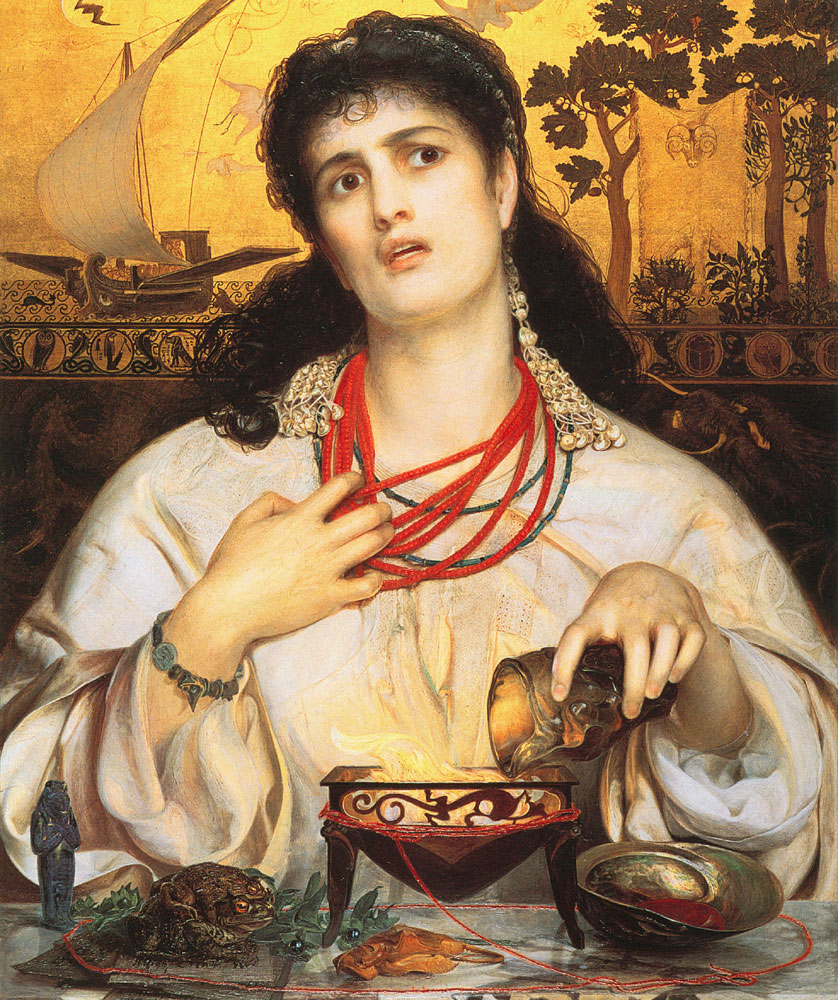 Frederick Sandys, Medea (1866–68). The Pre-Raphaelite vision of Hecate’s most famous mortal devotee, mid-incantation over the brazier. (Wikimedia Commons, public domain.)

Research Hub · Epithets · Magic & Mysticism · Cross-Cultural Parallels · Campaign Hooks
Hecate does not have a mythology in the ordinary sense. She almost never stars in her own stories; instead she arrives at pivotal moments in other people’s myths, at the moment of abduction, at the moment of oath, at the moment of sorcery, and inflects them. What follows is a tour of the primary-source passages in rough chronological order. A map of her titles and functions is kept separately on Epithets and Titles.
Hesiod
The oldest surviving reference to Hecate is also, paradoxically, the most generous. Hesiod’s Theogony (c. 700 BCE), lines 411–452, interrupts its cosmogonic catalogue to spend forty lines extolling her, an amount of space given to no other deity in the poem.
Hesiod makes her the only child of the Titans Perses (“the destroyer” or “the one who ravages”) and Asteria (“the starry one,” sister of Leto and mother, through Hecate, of a line of cosmic light). This parentage makes her a cousin of Artemis and Apollo and ties her to the generation before the Olympians.
He then declares (and this is the remarkable claim) that Zeus, even after overthrowing the Titans, chose to preserve and increase Hecate’s honours. She retains a triple portion of the cosmos, earth, sea, and starry heaven; she sits beside kings in judgement and grants the verdicts that work; she stands by warriors in battle and hands them victory; she grants good catches to fishermen, prosperity to herdsmen, and safe birth to women. She is a kourotrophos, a nurturer of children.
The Theogony’s Hecate is, in other words, not a dark goddess. She is almost a universal benefactress. Modern scholarship has read this passage as evidence that Hesiod’s immediate community (Boeotia, or the broader Anatolian sphere that influenced him) worshipped Hecate as a high goddess of the Great Mother type (see Carian and Anatolian Roots), and that the familiar night-goddess image is a later accretion.
The Homeric Hymn to Demeter
The second earliest substantial passage is the Homeric Hymn to Demeter (7th–6th century BCE), the founding text of the Eleusinian narrative.
When Hades seizes Persephone, it is Hecate who hears her cry. She is alone in her cave. She does not see the abduction (that detail is reserved for Helios, the sun), but she is the only other divine witness to the sound. On the tenth day of Demeter’s searching, Hecate appears bearing a torch and offers what she knows. She then accompanies Demeter to Helios, and from that meeting onwards becomes Persephone’s permanent companion.
After the compromise that returns Persephone to the upper world for two-thirds of the year, Hecate is described as going before her as her guide and remaining with her as “her minister and attendant” (propolos kai opaōn). She is not queen of the underworld (that is Persephone), but she is the one who holds the torches that show Persephone the way in and the way out. This is the kernel of every later depiction of Hecate as guide of souls.
Aeschylus and Euripides
The fifth-century Athenian tragedians are where Hecate’s witch-queen identity crystallises.
Aeschylus names her in the Suppliants as a protectress of women in childbirth, consistent with Hesiod. The shift comes in Euripides, where she becomes the explicit patroness of sorcery. In the Medea (431 BCE), Medea swears her bloodiest oath by Hecate, “mistress whom I revere above all others and have chosen as my helper, who dwells in the inmost chamber of my hearth.” The passage is important because it shows Hecate not as a goddess one encounters at crossroads but as a goddess inside the house, in the hearth-shrine of a woman who does magic.
Medea of Colchis
The most developed mythological association is with Medea. The consistent ancient tradition (found in Euripides, Apollonius, Diodorus, and Ovid) is that Medea learned her craft directly from Hecate and served as her priestess in Colchis. Some genealogies, particularly in Diodorus Siculus, go further and make Hecate Medea’s aunt (via a tortured genealogy in which Perses is Aeëtes’s brother).
In Apollonius Rhodius’s Argonautica Book 3 (3rd century BCE), Medea instructs Jason in the only ritual anywhere in surviving Greek literature that can reasonably be called a working of Hecate:
At midnight, having bathed in an ever-flowing river and dressed in dark robes, he is to dig a round pit. Over it he cuts the throat of a female black lamb. He burns the whole animal over the pit as a holocaust and pours libations of honey, calling on Hecate. Then, without turning round on any account, he is to walk home.
Three details recur in every later Hecate ritual: the pit (communication with the chthonic realm), the holocaust (the offering is not shared with the worshipper; it belongs entirely to the goddess), and the injunction not to look back. The refusal to look back is the single most common ritual signature of Hecate and reappears in the Deipnon two thousand years later.
Theocritus and the Idyll of the Sorceresses
Theocritus’s Idyll 2 (c. 270 BCE), usually called “The Sorceresses” or “Pharmakeutriai,” is the single most detailed surviving depiction of a private love-spell from the classical world. A woman named Simaetha, abandoned by her lover, performs a ritual on a rooftop at night, calling down Hecate and the moon together. “Hecate of the underworld, at whose coming the very dogs of the farm shudder as she walks over the graves of the dead and over the black blood…”
Theocritus’s Hecate here is Selene, is Artemis, is the moon, is all of them at once, a syncretism discussed on The Lunar Triad.
Ovid and Lucan: the Roman Dark Hecate
Roman poets intensify the ghoulish register. Ovid’s Metamorphoses gives Medea a second great invocation (Book 7) in which she calls on triple Hecate alongside “night, stars, and the Moon,” and later (Book 14) inserts Hecate into the Circe narrative. Lucan’s Pharsalia Book 6: the celebrated episode of the Thessalian witch Erichtho, who reanimates a corpse to prophesy the outcome of Pharsalus, making Hecate and Persephone the dread powers of the grave who answer to necromancers. Erichtho is the literary ancestor of every gothic necromancer in the Western tradition; the ritual she performs is a virtuoso compression of Apollonius’s Hecate-rite and the Odyssey’s Nekyia.
The Gigantomachy
Later Greek sources (notably Apollodorus) slot Hecate into the Gigantomachy, where she fights alongside the Olympians against the Giants and slays the Giant Klytios with torches. This is the single episode in which she appears as an active combatant in a divine narrative.
Minor Stories
A handful of smaller myths round out her mythological profile.
Hecuba’s transformation. After Troy falls, the grief-maddened queen Hecuba blinds the Thracian king Polymestor. She is then transformed into a black dog; Hecate claims her as a companion. This is the mythical source of Hecate’s particular association with black dogs.
Galinthias the midwife. During Alcmene’s protracted labour with Heracles, the Moirai (Fates) are binding up the birth at Hera’s request. Galinthias, Alcmene’s servant, tricks them by running in and announcing that the child is already born; startled, the Fates release their hold and Heracles is born. As punishment, they transform Galinthias into a polecat or weasel. Hecate, moved by her cleverness, adopts her as her own animal. This is the source of her association with the polecat.
Iphigenia at Aulis. In one variant of the Iphigenia myth (notably Stesichorus, fragmentary), the girl sacrificed at Aulis is not killed but translated and becomes identified with Hecate herself, an echo of the broader Artemis–Hecate assimilation.
Iambe / Baubo. Some Orphic traditions identify Hecate with the figure who makes Demeter laugh in the Homeric Hymn.
Orphic and Late Antique Expansions
In the Orphic Hymns (late Hellenistic/Imperial), Hymn 1 is dedicated to Hecate. The hymn addresses her as Einodia, Trioditis, “lovely lady of the infernal world,” “wandering through the graves with the souls of the dead,” “rejoicing in the deer,” “huntress,” “bull-herder,” “nurturer of youth,” and “mountain-wanderer.” The accumulation of epithets is the point: she has become all goddesses, a henotheistic summit in which the individual shape of the deity is deliberately dissolved.
By the time of the Chaldean Oracles (discussed on Chaldean Oracles and Theurgy), she has ascended past mythology altogether and become a cosmic principle.
The Overall Shape
Placed in sequence, the mythological record traces a long arc: Hesiod’s universal Titaness → the compassionate guide of the Homeric Hymn → Euripides’s hearth-patroness of the sorceress → Apollonius’s goddess of the pit and the ewe → Theocritus’s moon of lovers’ spells → Lucan’s queen of the necromantic grave → the Orphic “all-goddess” → the Chaldean World Soul. She is, in one sense, the same goddess throughout. In another sense, every age projects onto her what it most needs the divine feminine to be.
The next page examines the names under which each of these ages called her: Epithets and Titles. ����������������������