Research Hub
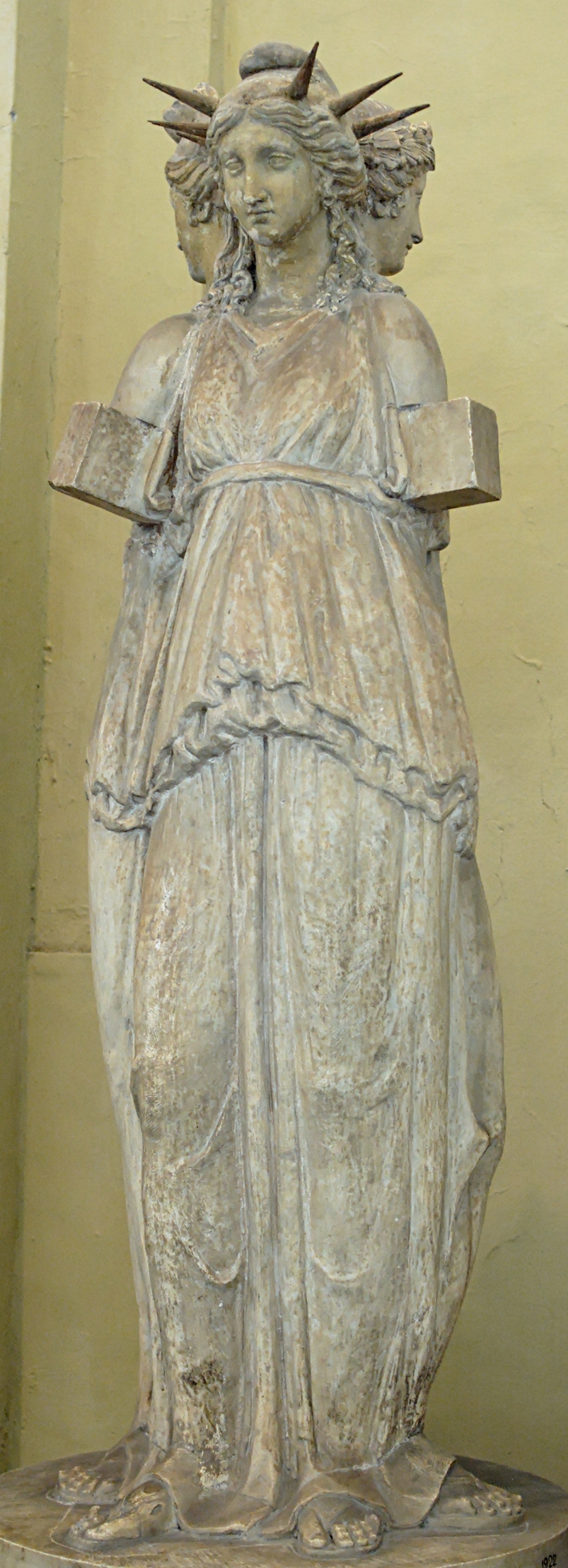 The Hecate Chiaramonti , a Roman copy after a Hellenistic original showing the trimorphos triple-bodied form. Vatican Museums. (Wikimedia Commons, public domain.)

Player-facing overview
Looking for the short “what is Hecate?” page for players? See Hecate in the Player Guide. This hub is the in-depth research companion for the GM.
Hecate (Greek Ἑκάτη, Hekátē, “she who works from afar” or “she who has power from afar”) is among the most enigmatic figures in Greek religion. Across a thousand years of recorded practice she is at once a Titaness older than the Olympians, a protectress of homes, a midwife of childbirth, a feeder of dogs, a queen of restless ghosts, the world-soul of the Chaldean Oracles, and the patroness of every witch worth naming, from Medea to the petty cursers of classical Athens. She is consistently liminal: she stands where two states meet, and she grants passage (or refuses it).
This page is a hub for research compiled for The Sanctuary of Hecate. It summarises her identity and then points to deeper pages on the major aspects of her cult.
Capsule Biography
Per Hesiod’s Theogony (c. 700 BCE), Hecate is the only child of the Titans Perses and Asteria, making her a cousin of Artemis and Apollo. Hesiod calls her the most honoured of all beings: Zeus granted her a portion of earth, sea, and starry heaven, and the privilege of granting or withholding success to mortals in every sphere of life. Unusually for a Titan, she kept every gift she was born with after the Olympians rose to power.
Her worship probably did not originate in Greece at all. The most persuasive reconstruction places her origin in Caria, in south-western Anatolia, where her great temple at Lagina was served by eunuchs and theophoric names built from Hekat- (Hecataeus, Hecatomnus) cluster thickly. Her iconography (a solitary goddess flanked by wild beasts) resembles Anatolian mother goddesses such as the Phrygian Cybele and Ephesian Artemis more than anything native to the Greek mainland. See Cross-Cultural Parallels for the full argument.
By the Classical period she was absorbed into the Greek pantheon but retained an outsider’s character. In the Homeric Hymn to Demeter she is the one divinity who hears Persephone’s screams from her cave, and afterwards becomes Persephone’s perpetual companion in the underworld. By the fifth century BCE she is the explicit patron of sorceresses: the tragedian Euripides makes her the goddess Medea swears by, and Apollonius Rhodius’s Argonautica shows Jason performing a literal Hecate invocation, complete with dark robes, a ewe sacrificed over a pit, and instructions not to look back.
Later still, in the Chaldean Oracles (2nd century CE) and the Neoplatonic tradition that absorbed them, she ascends to an extraordinary metaphysical height: World Soul, the intermediary membrane between the supreme Fire of the Father and the material cosmos, the cosmic channel through which every soul descends into the body and (if it is lucky, and knows the rites) ascends back out.
The Four Faces of Hecate
No single source gives the full picture. It is most useful to think of her as accumulating four distinct “faces” over time, each of which the Sanctuary can draw from.
The Cosmic Titan of Hesiod is pre-Olympian, universal, and benevolent: a grantor of success in court, in war, at sea, at the harvest, over the birth of children and the rearing of herds. She is nobody’s dark goddess here; she is closer to Fortuna.
The Threshold Guardian of civic Greek practice stands outside the door. Her statues (Hekataia) were erected before private houses and at city gates as Propylaia, “she before the gate.” Her name for the crossroads, Trioditis, marked the Y-junctions where her shrines received monthly offerings; see the Deipnon.
The Queen of Witches emerges in Greek tragedy and becomes dominant in the Greek Magical Papyri. She walks the night with a howling train of dogs and the unhoused dead; she teaches the herbs of healing and the herbs of murder; she is the deity whom the anonymous writers of curse tablets address when they want a rival silenced.
The World Soul of the Chaldean Oracles is the most philosophically exalted Hecate: a cosmic principle of mediation, vivification, and return. She is the channel down which divine fire falls into matter and the ladder up which the theurgist climbs.
All four faces can coexist. In practice, Late Antique Hecate was understood as a single goddess whose torch could be raised on the doorstep of a farmhouse or on the threshold of the cosmos with equal propriety.
Iconography and Sacred Animals
Hecate is almost always depicted with one or more of the following:
- Twin torches (the lampadephoros aspect), so she may illuminate thresholds and guide the dead.
- Keys (the kleidouchos aspect), especially the keys of Hades; she opens and she closes.
- A whip, rope, or serpent, for binding; the Chaldean Oracles name the iynx wheel among her instruments.
- A pair of daggers, for cutting through what must be severed.
- Dogs, especially black ones, often howling around her as she walks at night. Hecuba of Troy was transformed into a black dog and became her familiar.
- Serpents entwined around her arms or in her hair.
- The polecat / weasel, owed to the myth of Galinthias the midwife, who was transformed into a polecat and adopted by Hecate after tricking the Fates.
- In the PGM she is described as three-headed: one head a dog, one a serpent, one a horse.
From the late fifth century BCE onwards she is increasingly shown triple-bodied, three full statues standing back-to-back around a central pillar (the trimorphos or triformis type). Later Roman art consolidates this into a single body with three heads or three faces looking outward in three directions. The triple form is usually read as an expression of her dominion over heaven, earth, and underworld, and of her watchfulness over three-way crossroads.
Further Reading (Internal)
- Mythological Narratives: the primary sources: Hesiod, the Homeric Hymn, Aeschylus, Euripides, Apollonius, Ovid, Lucan.
- Epithets and Titles: a working glossary of the titles under which she was invoked.
- Magic and Mysticism: cult practice, the Deipnon, the Greek Magical Papyri, the Chaldean Oracles, curse tablets.
- Cross-Cultural Parallels: Trivia, Artemis–Selene–Hecate, Isis, Heqet, Baba Yaga, the Morrígan, Kali, Lilith, Papa Legba, and the Proto-Indo-European substrate.
- Campaign Hooks: how this material can be used in the The Sanctuary of Hecate Curseborne campaign.
Primary Ancient Sources at a Glance
The following are the earliest and most load-bearing ancient sources. Each is summarised on Mythological Narratives.
Hesiod, Theogony 411–452 (c. 700 BCE): the foundational hymn to Hecate. The Homeric Hymn to Demeter (7th–6th c. BCE): the Persephone narrative. Aeschylus, Suppliants; Euripides, Medea: Hecate as patron of the witch. Apollonius Rhodius, Argonautica Book 3 (3rd c. BCE): Jason’s rite of Hecate. Theocritus, Idyll 2 (“The Sorceresses”): love-magic addressed to Hecate–Selene. Ovid, Metamorphoses 7 and 14; Lucan, Pharsalia 6 (Erichtho): Roman dark Hecate. The Chaldean Oracles, fragments (2nd c. CE): Hecate as World Soul. Papyri Graecae Magicae IV.2708–2784 and parallels (2nd–5th c. CE): ritual invocations.
A Note on Sources Used in Compilation
This research digest was compiled from general reference works (Wikipedia, Theoi.com, World History Encyclopedia, Mythopedia), Bryn Mawr Classical Review and academic summaries for the Chaldean Oracles, and modern practitioner communities (Covenant of Hekate, Hellenion, hekatecovenant.com) for the continuity of cult. All claims about classical mythology are pulled from multiple independent sources where possible; where interpretation is modern rather than ancient (for example, the Maiden–Mother–Crone framing) this is noted on the relevant sub-page. ����������������������