Cross-Cultural Parallels
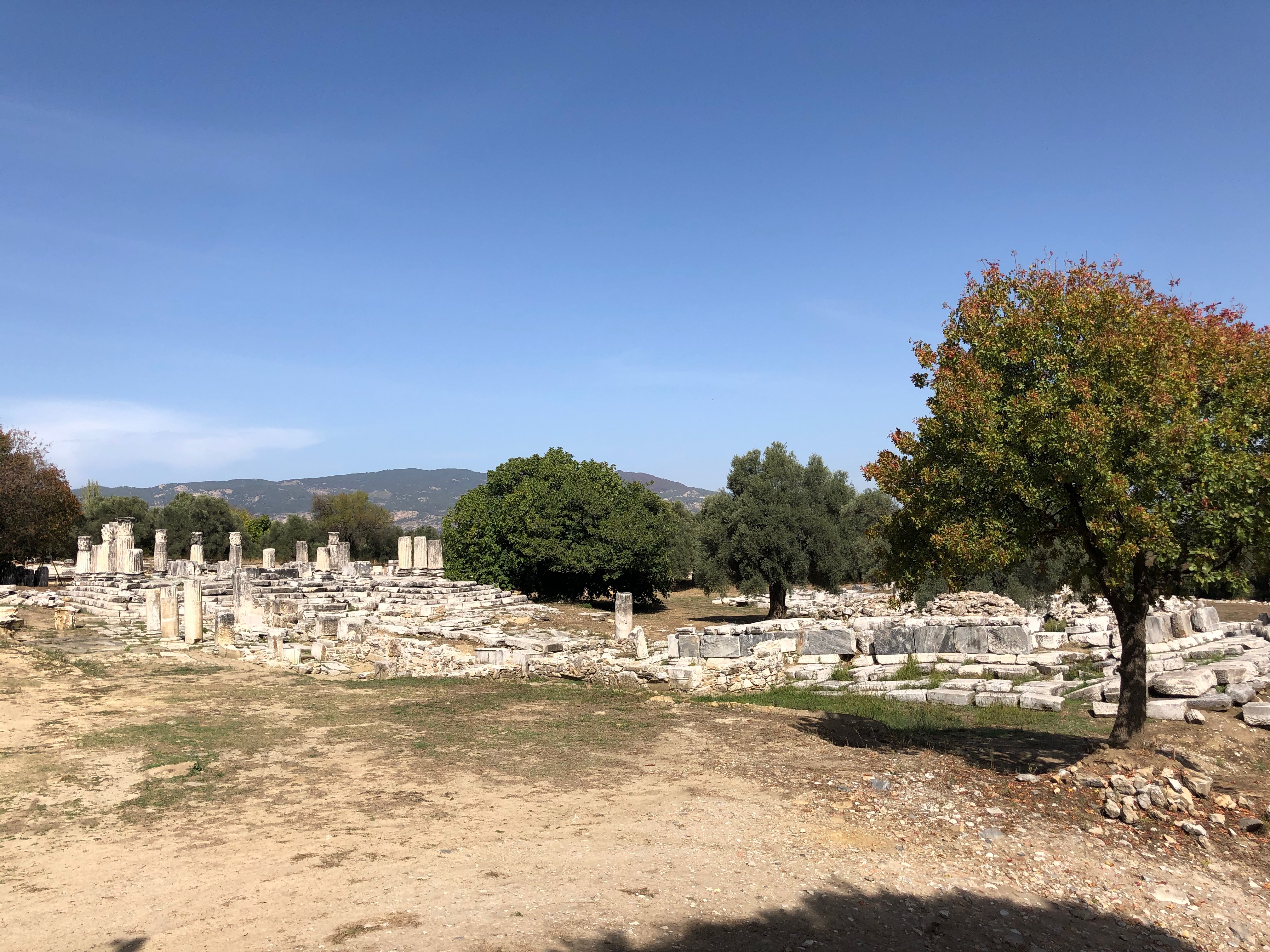 The ruins of the Temple of Hekate at Lagina, Caria (south-west Anatolia), her greatest and probably oldest sanctuary, and the likely geographical source of the cult that Greek poets later inherited. (Photograph Raicem, Wikimedia Commons, CC BY-SA 4.0.)

Research Hub · Mythological Narratives · Epithets · Magic & Mysticism · Campaign Hooks
Hecate does not stand alone in world mythology. The same figure (or, at least, a figure doing the same job) recurs across an extraordinary range of cultures. In every case she is a woman (or woman-shaped power) who stands at the threshold: between light and dark, life and death, civilisation and wilderness, above and below. She holds a key, or a torch, or a sickle, or the bones of the dead; dogs attend her, or crows, or serpents; she is sometimes beautiful and sometimes monstrous and often both at once. What follows is an inventory, organised roughly by geographic proximity, of figures with whom Hecate has been explicitly identified in antiquity or productively compared in modern scholarship.
A word of caution before proceeding: similarity is not identity. Ancient syncretism sometimes merged two goddesses into a single cult (Hecate–Artemis, Hecate–Selene), and in those cases we can speak of direct equivalence. Modern comparative mythology (especially in its Jungian, Neopagan, or “dark goddess” varieties) is looser; it identifies archetypal kinship rather than historical continuity. Both kinds of parallel are included here, but flagged.
Carian and Anatolian Roots
The most likely real ancestor of Hecate lies not in Greece at all but in Anatolia. Theophoric names of the form Hekat- (Hecataeus, Hecatomnus, Hecate’s dynasty of Caria) are heavily concentrated in Caria in the south-west of modern Turkey. Her greatest and oldest temple, at Lagina, was in Caria and was served by eunuchs, a priestly organisation otherwise Anatolian rather than Greek. Between Lagina and the nearby city of Stratonikeia, an annual Kleidos Agōgē (“procession of the key”) carried the temple key ceremonially between the two, echoing her Greek cult title Kleidouchos.
The deities she most resembles in Anatolian context are:
Cybele (Phrygian Matar Kubileya, “Mountain Mother”): a great mother goddess whose ecstatic cult involved castrated priests (Galli), torches, and wild animals flanking her. Like Hecate she was a universal mother figure who extended her power over earth and heaven.
The Ephesian Artemis: not the huntress maiden of mainland Greece but the Anatolian polymastic (many-breasted) mother-goddess of Ephesus, flanked by wild beasts, served by eunuch priests called Megabyzoi. Ephesian Artemis is effectively a Greek name pasted onto a local great-goddess cult, and Hecate’s cult may have been similar: a Greek name for a Carian mother.
Heqet of Egypt (see below): sometimes invoked as a phonetic ancestor of the name Hekátē. This is controversial but not impossible; Middle Egyptian Hqt would have sounded close to /ħaˈqaːtat/.
The Carian-origin hypothesis does not require rejection of Hesiod’s Greek genealogy for her. It simply suggests that the Greek poets inherited her name and her high dignity from their Anatolian neighbours and then grafted her onto their own cosmogony.
Artemis and Apollo
Hecate’s cousinship with Artemis is mythologically formal: Asteria, Hecate’s mother, is the sister of Leto, Artemis’s mother. But the relationship is deeper than genealogy. Artemis and Hecate share:
- torches;
- dogs;
- the title Tauropolos (bull-tender);
- roles as protectresses of children and of women in childbirth (Artemis as Eileithyia-like, Hecate as Kourotrophos);
- an association with the moon (later);
- an outsider status among the Olympians (Artemis is of them but apart; Hecate is older and even more apart).
By the 5th century BCE, ritual poetry freely blurs them. By the PGM they are treated as the same deity under different names. In Sparta, a single cult figure called Artemis–Hecate received offerings under both names.
The Lunar Triad
The late antique world produced a standard triple moon goddess: Artemis as the maiden huntress, Selene as the full moon in the sky, Hecate as the dark moon and underworld. The classical formulation is from Ovid: tergemina Hecate, tria virginis ora Dianae. The Greek Magical Papyri use the triad directly, addressing all three as aspects of one goddess.
This triad is the direct ancestor of the Maiden–Mother–Crone of modern Neopaganism, though the specific Neopagan formulation (invented by Robert Graves in The White Goddess, 1948, and popularised by Wicca) is not ancient. No classical source ever assigns Hecate the Crone role specifically; she is typically represented in ancient art as a young woman (often three young women). The “Crone” identification is modern. But the underlying triple-lunar structure is genuinely classical.
Trivia: The Roman Hecate
In Roman religion, Hecate was imported under her Greek name, but her Greek title Trioditis was translated as Trivia, “of the three ways.” Trivia was in turn identified with Diana in her three-form aspect. Virgil’s invocation of tergemina Hecate, tria virginis ora Dianae explicitly fuses the two: “triple Hecate, three-faced Diana-virgin.” In the sacred grove of Diana at Nemi, the great cult centre near Rome, Diana was venerated as Diana Trivia and her priest was the Rex Nemorensis, a former slave who held his office by murdering his predecessor in single combat, a ritual ferocity that underlines how much Hecatean shadow was in Diana’s Italian form.
This Diana-Trivia is the immediate ancestor of Diana of the witches in medieval and early modern European folklore, the goddess whose name the Canon Episcopi (10th century) denounces as the “mistress of the witches’ flight,” and whom Charles Godfrey Leland’s Aradia, or the Gospel of the Witches (1899) elevated to the head of a claimed Tuscan witch tradition. The Hecate-Diana-Aradia chain is one of the most important lines of transmission by which classical imagery of the goddess-of-witches survived into modernity.
Isis
In the Hellenistic world, Isis became a universal goddess onto whom every other female deity was mapped, the so-called Isis-Pantheos. Apuleius’s Golden Ass (2nd century CE) contains the famous aretalogy in which Isis declares herself to be Juno, Bellona, Hecate, Proserpina, and Venus all at once, “known by innumerable names to the people of the many races.” Hecate and Isis shared the torch, the lunar association, the role as guide to mysteries, and the patronage of magicians (Isis was called Hermetika as patroness of Hermetic magic). In the PGM they are freely identified.
Heqet of Egypt
Heqet (or Heket) was an Egyptian goddess of fertility and childbirth, represented as a frog or a frog-headed woman. She was believed to assist at the moment of birth and was petitioned by midwives; in some traditions she breathed life into the clay bodies that Khnum shaped on his potter’s wheel. Proposed parallels with Hecate rest on:
- the phonetic similarity of the names (Middle Egyptian Hqt → something like Hekat-);
- the role as patroness of midwives (Hecate’s Kourotrophos aspect);
- the frog’s association with the Nile flood and rebirth (parallel to Hecate’s chthonic and regenerative aspects);
- general Egyptian–Greek syncretism in the magical tradition.
Most scholars are sceptical that the names are actually cognate. The functional similarity is real: both are goddesses of the threshold of birth, but it is of a kind that appears in many cultures and does not require direct borrowing. What is undeniable is that by the time of the PGM, Egyptian and Greek magical categories were fully interchangeable, and Hecate was regularly given Egyptian attributes.
Ereshkigal and the Mesopotamian Underworld
Ereshkigal is the Sumerian-Akkadian queen of the underworld, the dreadful older sister of Inanna-Ishtar. Ereshkigal does not share Hecate’s roles of midwife or crossroads-guide; her dominion is strictly chthonic. But the Late Antique syncretism was direct: the PGM (e.g. PGM LXX) addresses “Hecate Ereschigal” as a single deity, and a well-known invocation gives her fused epithets of both. In this fusion, Hecate acquires Ereshkigal’s bleaker associations (terror of death, absolute power over the dead), and Ereshkigal in the Greek world acquires Hecate’s witch aspect.
This is also the clearest case we have of Greek magic reaching outside the Greek cultural sphere for a darker identity for Hecate.
Trinities in Celtic Religion: The Morrígan and Brigid
The Morrígan is an Irish goddess of war, sovereignty, and fate. Like Hecate, she is sometimes a single goddess and sometimes three: the Morrígna, variously named Badb, Macha, and Anand (or Nemain, or Morrígan herself). Like Hecate, she is associated with liminal sites: the battlefield, the ford, the boundary between territories. Her sacred animal is the crow or raven, the equivalent of Hecate’s dog as a bird of carrion and omen. She is a prophesying goddess who can appear in three forms.
Differences are significant. The Morrígan’s domain is specifically sovereignty: the mystical legitimacy of kingship, tied to the land, and battle, which Hecate’s Greek cult does not really touch. Hecate’s world is the household threshold, the crossroads, the birthing room, and the grave; the Morrígan’s is the battlefield and the ford.
Brigid offers a different Celtic parallel. She is triple (three sisters, all named Brigid, governing poetry, smithcraft, and healing), she is associated with fire and hearth, and she is a protectress of women in childbirth. Her saintly Christian successor, St Brigid of Kildare, inherited the fire-keeping and midwifery functions. Brigid is closer to Hecate’s Kourotrophos and Phosphoros aspects than the Morrígan is.
Neither identification is ancient. Roman-era writers knew the Celtic gods and occasionally mapped them onto the Greek pantheon (interpretatio Romana), but the Morrígan and Hecate are not so equated in any surviving ancient source. The parallels are structural: both cultures independently produced a goddess of triple aspect, feminine fate, and the terrifying edge of life.
Baba Yaga
Baba Yaga of East Slavic folklore is a far more developed liminal figure than the Morrígan. She lives in a hut on chicken legs in the deep forest, the boundary between civilised human settlement and the wild, and the hut turns to face the seeker or not, granting or refusing passage. She flies in a mortar, sweeping her traces with a broom. She tests heroes. Those who pass her tests are often granted decisive magical aid (fire, horses, knowledge); those who fail are eaten.
Baba Yaga’s structural parallels with Hecate are precise. Both are threshold guardians who grant or refuse passage. Both are figures of transformation: Baba Yaga’s tests remake the seeker, just as Hecate’s is the cosmic channel through which souls are recast in the Chaldean scheme. Both are accompanied by unusual animals or servants (Baba Yaga’s geese and knights of day, dawn and night; Hecate’s dogs and restless dead). Both are frightening but not simply evil; they operate by a logic of initiation.
Some modern practitioners place them, along with the Sumerian Ereshkigal, in a single “threefold crone” framework (see the self-consciously modern “Power of Three” used by some Hecatean Witchcraft traditions). This is modern synthesis rather than ancient cult, but it is a useful reading.
The Hindu Parallel: Kali
Kali is the most commonly named parallel in modern “dark goddess” literature. She is a goddess of time, destruction, and liberation in Shakta Hinduism. Her iconography includes a necklace of severed heads, protruding tongue, four arms bearing weapons, and a girdle of severed arms. She dances on the body of Shiva. She is both destroyer of demons and compassionate mother of her devotees.
Her direct structural parallels with Hecate are limited. Kali’s metaphysical weight, as the force that ends cycles and makes possible new beginnings, does resemble the Chaldean Hecate’s cosmic function (she who receives the soul at the threshold of death and releases it at the threshold of new life). Both are addressed by devotees who seek not avoidance of death but initiation through death into a transformed state. Both are extraordinarily frightening deities whose terror is, in the fullness of their devotion, a face of grace.
But Kali is a goddess of time and of the absolute; Hecate is a goddess of the threshold between worlds. Their work overlaps at the edges rather than the centre.
Lilith
Lilith entered the Western mythological imagination as a demonic figure of Babylonian-Jewish folklore: in the Alphabet of Ben Sira (c. 8th–10th century CE), she is Adam’s first wife, created equal to him, who refused to be subject to him and fled. In older Akkadian and later Kabbalistic traditions she is a night-demon who stalks children and men. Modern feminist occultism has reclaimed her as a goddess of sovereignty and refusal.
Lilith’s parallels with Hecate are primarily modern. Both are cast as the “dark feminine”, the woman who will not be contained by the patriarchal order, who rules the night, who is at home with animals (Lilith’s screech-owls, Hecate’s dogs). In Late Antique magical practice they occupied a common register: Jewish magical texts invoke Lilith in bowl-inscriptions that resemble Greek curse-tablet addresses to Hecate, and the PGM freely combines Greek, Jewish, and Egyptian figures.
The substantive theological parallel is weaker. Hecate is, in her high cult, a benevolent universal goddess; Lilith in her earliest attested form is a hostile night-demon specifically targeting pregnant women and babies. The demonic Lilith is closer to the Lamia or the Gello of Greek demonology than to Hecate herself.
Crossroads Deities Beyond Europe
The crossroads as a site of spiritual power is one of the most genuinely cross-cultural mythological motifs. Hecate is its classical guardian, but she has peers:
Hermes: her Greek partner, herms flanking doors and roadways alongside Hekataia. Where Hecate guards the vertical threshold (between realms), Hermes guards the horizontal one (between places). Together they form a complete threshold cult.
Janus: the Roman god of doorways, gates, beginnings, and transitions. Two-faced rather than three, but the function is the same. Where Trivia/Hecate marks the three-way intersection outside, Janus marks the doorway itself. The two were not formally identified in antiquity but they were functional complements.
Eshu / Elegua / Papa Legba: the Yoruba orisha of the crossroads, preserved in the diaspora as Elegua (Santería), Exu (Candomblé), and Papa Legba (Vodou). Papa Legba is the gatekeeper between the human and spirit worlds; no ritual may begin without first addressing him. He speaks every language; he holds the keys of all passages. The parallels with Hecate are extremely close; both hold the keys, both stand at the crossroads, both must be propitiated first before other spirits may be contacted, and the comparison has been made in both scholarly and practitioner literature. It is likely that the resemblance is an example of independent convergent development: human cultures that locate spiritual power at the crossroads will tend to produce a deity who mediates there.
Ogun at the crossroads also has a similar role in some Yoruba and Afro-Caribbean traditions, particularly in iron-working and the way of the warrior.
Hel: the Norse goddess of the underworld, who presides at the gate Nágrind where the dead enter her realm. She shares Hecate’s keyholder aspect, though she is less a threshold-goddess than an underworld-queen in the Persephone mould.
The Proto-Indo-European Substrate
A brief and more speculative note. Proto-Indo-European mythology (reconstructed from Vedic, Greek, Roman, Germanic, Slavic, and Celtic sources) hosts a dawn goddess, H₂éwsōs, from whom Greek Eos, Latin Aurora, Vedic Uṣás, Lithuanian Aušrinė, and Slavic Zorya all descend. She is the crosser of the boundary between night and day, the opener of the heavenly gates. Her functional relationship to Hecate, as guardian of the threshold between light and dark, is obvious, and some comparatists have proposed that Hecate represents the nocturnal counterpart to the dawn goddess, occupying the other transitional gate of the sky.
Jean Haudry’s three-heavens cosmological model (diurnal, nocturnal, and liminal) provides a framework: Hecate is associated with the nocturnal and liminal skies rather than the diurnal. In this reading, Hecate and the PIE dawn goddess are paired opposites, each guarding one end of the day. This is speculative but elegant.
Synthesis: What the Parallels Reveal
Reviewing the comparanda, four features recur:
First, the triadic or polymorphic form (one goddess as three, or one goddess shifting among aspects) is extraordinarily widespread. Greek Hecate, Roman Diana-Trivia, Irish Morrígna, Irish three Brigids, the Norse Norns, the Slavic Zorya, Hindu Tripurasundari, the three-faced statues of Hecate herself: a triple feminine divinity is one of the most durable forms of religious thought. Modern psychology (Jung) and modern Neopaganism have grasped this pattern, though often with looser fidelity to particular traditions than the scholarship permits.
Second, the threshold (the door, the gate, the crossroads, the forest edge, the ford, the shore) is a universal locus of spiritual power, and the figure who guards it is almost always a female or androgynous intermediary. Hecate is the most developed European form of this figure, but she is not unique to any culture.
Third, the dual register (benevolent in her high cult and frightening in her low) is a recurring feature. Hesiod’s Hecate is Fortuna; Lucan’s is a ghoul. Kali nurtures her devotees and terrifies their enemies. The Morrígan incites heroes to battle and carries off the slain. Baba Yaga cooks the lazy and rewards the brave. The combination of terror and maternal compassion is the signature of the threshold goddess: she is frightening because the threshold is frightening, and she is kind because someone must help us across.
Fourth, and most tellingly for modern magical practice, the technique of syncretism itself is ancient. When the PGM invokes “Hecate-Selene-Artemis-Persephone-Brimo-Ereschigal-Iao,” the writer is not confused about who these deities are. The writer is deploying a deliberate technique of naming the goddess under as many aspects as possible, as a way of completing the invocation. This is how syncretism worked in the living magical tradition of the ancient world, and it is part of why the modern practice of reading Hecate against other dark feminine deities is not as anachronistic as it sometimes seems.
For how this comparative material might be brought to the gaming table of The Sanctuary of Hecate, see Campaign Hooks. ����������������������