Epithets and Titles
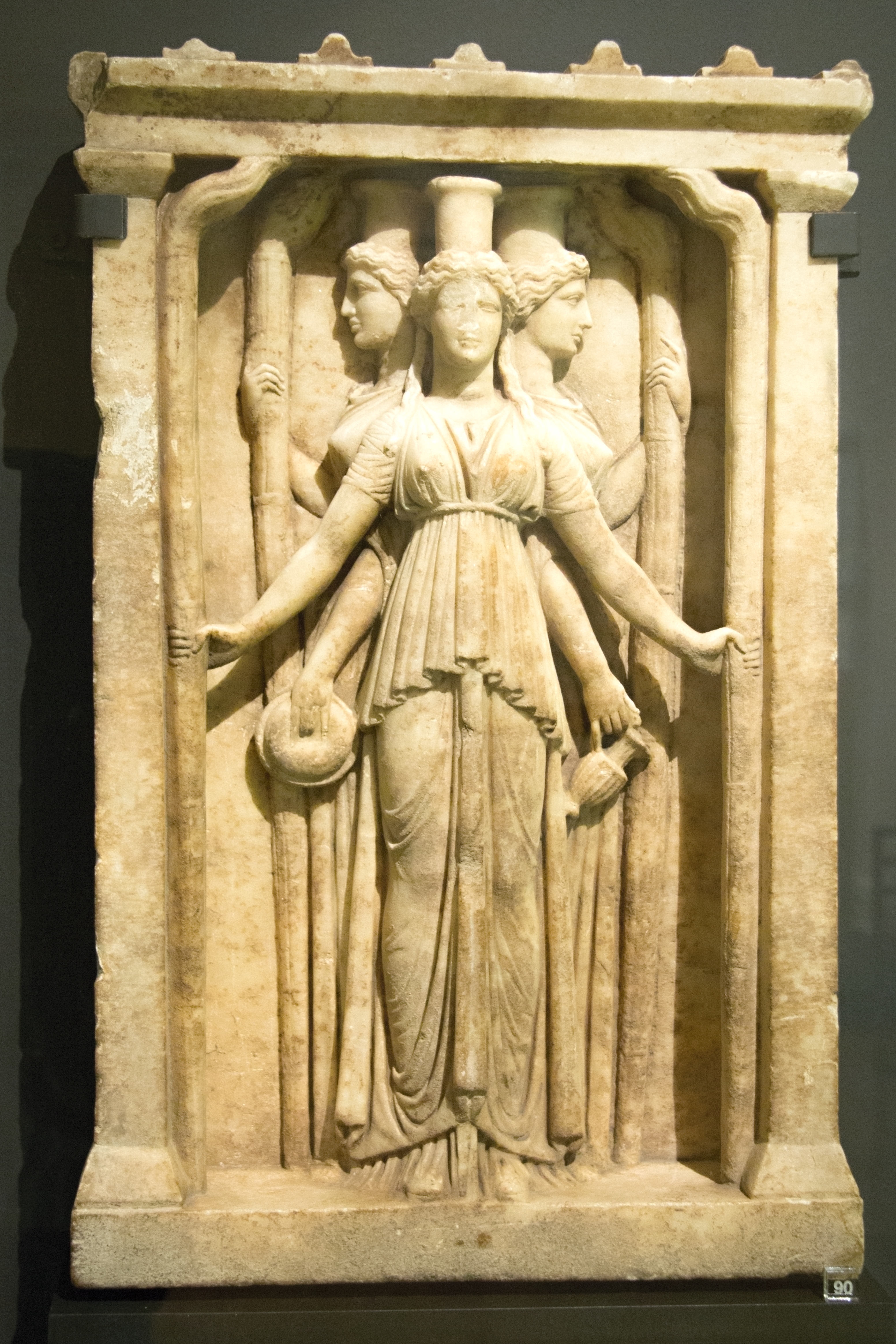 Marble relief of triplicate Hecate, Hadrianic classicism, three figures in aediculae wearing high poloi and bearing torches. National Gallery, Prague (Kinský Palace, NM-H10 4742). (Photograph Zde, Wikimedia Commons, CC BY-SA 3.0.)

Research Hub · Mythological Narratives · Magic & Mysticism · Cross-Cultural Parallels · Campaign Hooks
In Greek religious practice an epithet (epiklēsis) was not decoration. It was a target lock: it named the specific function of the deity a worshipper wanted to engage, and by implication excluded the others. To invoke Hecate Propylaia was to ask the goddess who stands before the gate, not the goddess who walks graveyards. What follows is a working glossary, organised by function rather than alphabetically, of the titles under which Hecate was invoked. Together they constitute a portrait of her cult.
Sources are noted where known. For the myths these epithets attach to, see Mythological Narratives.
Titles of Place
These are the epithets of the threshold Hecate: the goddess of where one thing meets another.
Trioditis (Τριοδῖτις, “of the three ways”): the most iconic. Her shrines stood at Y-junctions, the three-way crossroads that were understood as genuinely dangerous places where the dead might gather.
Trivia: the Roman translation of Trioditis; shared with Diana when invoked in her triple form. See Trivia: The Roman Hecate.
Enodia (Ἐνοδία, “she on the road” or “in the way”): a Thessalian cult title, older than the Attic Trioditis and originally belonging to a separate Thessalian goddess whose identity eventually fused with Hecate’s. Herodotus already treats them as one.
Propylaia (Προπυλαία, “she before the gate”): her civic cult title at the entrance to cities, temples, and private homes. The Hekataia, small triple-bodied statues, stood at Athenian front doors in this capacity.
Propolos (Πρόπολος, “she who goes before / attendant”): her role in the Homeric Hymn to Demeter as Persephone’s escort.
Phrouros / Phylax (Φρουρός, Φύλαξ, “watcher,” “guardian”): the apotropaic function: standing at the threshold and preventing harm from entering.
Kleidouchos (Κλειδοῦχος, “key-bearer,” “key-holder”): she who holds the keys, especially the keys of Hades. Ritually, a kleidouchos in a Greek temple was the priestess responsible for the sanctuary’s keys; applied to Hecate, the term means she holds the keys of existence itself.
Pandinia: “of all the gates”; Orphic.
Titles of Light
Hecate almost never travels without a torch.
Phosphoros (Φωσφόρος, “light-bearer”): the straightforward Greek; identical in form to the epithet of Lucifer/Venus as Morning Star, and sometimes confused with it.
Lampadephoros / Lampadios (Λαμπαδηφόρος / Λαμπαδιός, “torchbearer”): the cult title under which she saved Byzantium from Philip of Macedon in 340 BCE when (according to Suda and Hesychius) she lit torches in the sky and revealed the Macedonian night attack. The city minted coins with a crescent and a star in her honour; both symbols later became the badge of the Ottoman successor state.
Dadouchos (Δᾳδοῦχος, “torch-holder”): used interchangeably with Lampadephoros, and also the title of the torch-bearing priest of Eleusis.
Selasphoros (Σελασφόρος, “bringing brightness”): Orphic.
Titles of the Underworld
Chthonia (Χθονία, “of the earth / underworld”): her infernal aspect; a title also applied to Demeter and to Persephone. The ambiguity is not accidental.
Aidonaea (Ἀϊδωναία, “of Hades”): her most direct claim on the realm of the dead.
Nekuia / Nekrodegmōn: “she of the dead,” “receiver of the dead.”
Brimo (Βριμώ, “the roaring / raging one”): a title originally belonging to an independent Thessalian chthonic goddess who became identified with Hecate and Persephone. The name shares a root with English “brim”; it evokes something too full, overflowing. In the Argonautica, the name Brimo is a password-like invocation.
Titles of Magic and Night
Pharmakeia / Pharmakis: “drug-mistress,” “sorceress”; Hecate as the patroness of pharmaka, the plants that heal and kill.
Nyktipolos (Νυκτιπόλος, “she who wanders in the night”): an Orphic epithet.
Nyktiboia (“crying out in the night”): Orphic.
Skylakagetis / Skylakitis (“leader of dogs”): a rare but arresting epithet.
Perseis: “daughter of Perses”; used by Apollonius and Ovid when they want to evoke her witch aspect, because Perses puns on “the destroyer.”
Titles of Protection and Salvation
These are crucial for correcting the common modern misreading that Hecate is merely sinister.
Soteira (Σώτειρα, “savior”): her single most important cult title in the Chaldean Oracles and Neoplatonism; also used earlier of her protective aspect. For the Chaldean theurgists she is Soteira because she saves souls by offering them the channel of return.
Kourotrophos (Κουροτρόφος, “nurse of children”): from Hesiod onwards. She is a protector of the young.
Genetyllis: “birth-goddess”; associated with midwives.
Iatros: “healer.”
Titles of Cosmos
These are the Neoplatonic and Orphic promotions.
Pammētor (Παμμήτωρ, “mother of all”): Orphic.
Kosmos Psychē (“World Soul”): Chaldean; technically a description rather than an epithet, but functionally the highest name.
Zōogonos (“life-generating”): Chaldean.
Pantokrateira (“all-ruling”): late antique syncretism with Isis.
Tricephalos / Triformis / Trimorphos: “three-headed,” “three-bodied,” “three-formed.” Often used in Latin poets (Virgil: tergemina Hecate, tria virginis ora Dianae).
Titles of Animal and Form
Hecate’s iconography accumulated animal heads. PGM IV describes her with three: Kunokephalos (dog-headed), Hippokephalos (horse-headed), and Drakontokephalos (serpent-headed). These triple animal faces may be her earliest iconographic form and have parallels in Egyptian animal-headed deity art; see Heqet of Egypt for the tenuous Egyptian link.
Tauropolos (“bull-tender”): shared with Artemis and marking the overlap of their cults.
Tauropos (“bull-faced”): Orphic, perhaps related.
Geographical Cult Titles
Some epithets are tied to specific sanctuaries and festivals:
Lagynitis: of Lagina, her greatest temple, in Caria. The annual festival there was called the Hekatesia.
Stratia (“of the army”): at Stratonikeia in Caria, where she received a Kleidos Agōgē, a “procession of the key,” that carried the temple key from Lagina to the city and back.
Byzantine Lampadephoros: her civic savior-form at Byzantium, commemorated on city coins.
Phrontis: Boeotian.
Angelos (“messenger”): an obscure Syracusan cult where she is specifically a messenger of Persephone.
Titles in Syncretism
In the Papyri Graecae Magicae Hecate is regularly addressed by a cascade of fused identities:
Hecate-Selene-Artemis-Persephone-Brimo-Ereschigal-Neboutosoualeth…
This kind of listing is not confusion; it is technique. The magical procedure is to name the goddess under every aspect at once so that no channel of her power remains untouched. Ereschigal, incidentally, is Ereshkigal, the Mesopotamian queen of the underworld, evidence of how far the syncretism reached.
The Orphic Hymn 1 does the same work in a literary register, calling her at once Einodia, Perseia, Kourotrophos, Trioditis, “wandering among tombs,” “huntress,” “bull-herder,” “mountain-wanderer.” She is, in effect, a full pantheon compressed into one name.
Further Reading
- For the uses of these titles in actual myth, see Mythological Narratives.
- For their uses in actual rituals, see Magic and Mysticism.
- For which titles tie her to other cultures’ goddesses, see Cross-Cultural Parallels. ����������������������