Campaign Hooks for the Sanctuary
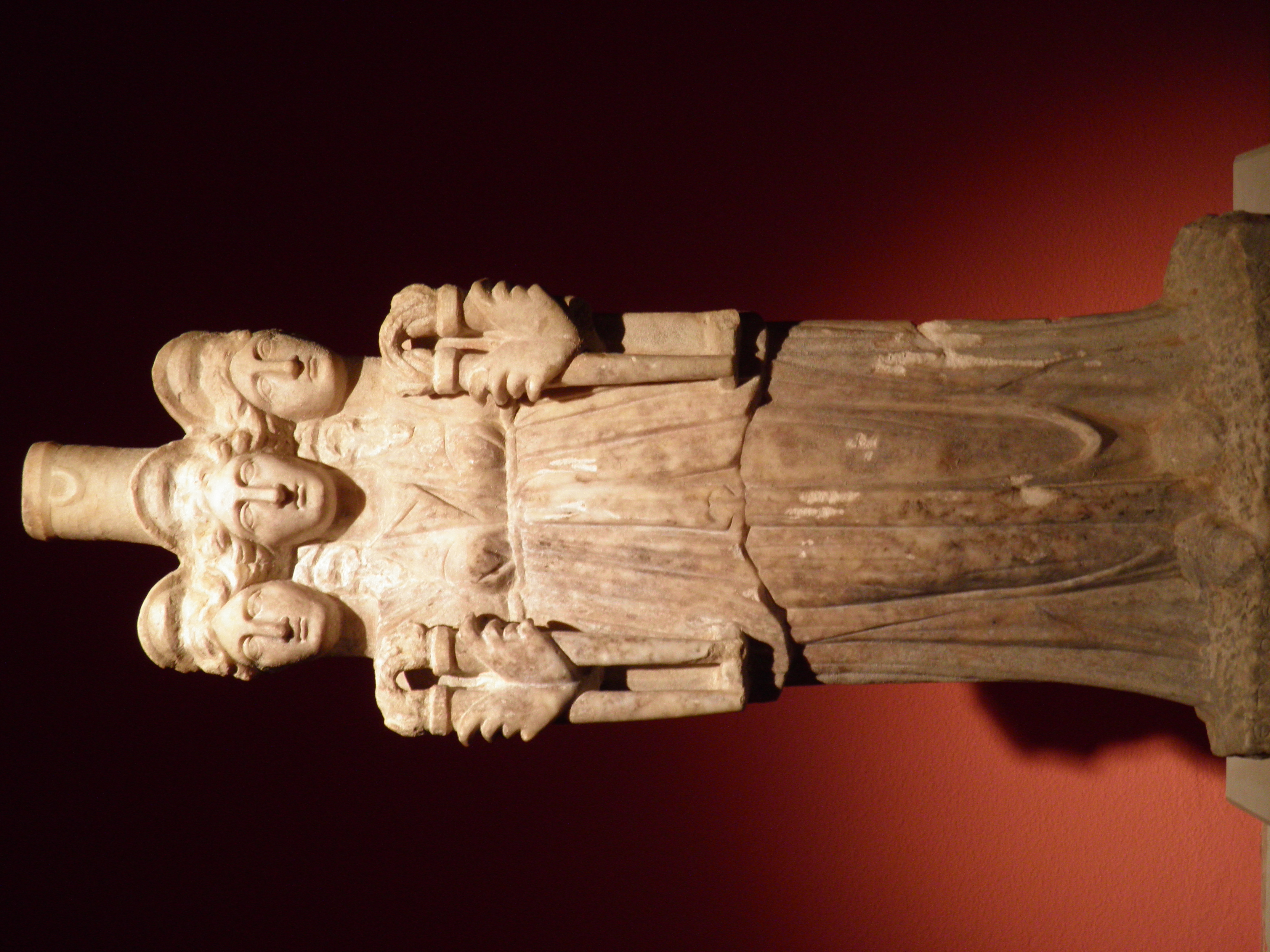 Statue of Hecate, 3rd century AD, from Yalvaç: the goddess in her polos crown, flanked and silent: the image the Sanctuary’s residents most often see in dreams. Antalya Museum, Turkey. (Photograph Carole Raddato, Wikimedia Commons, CC BY-SA 2.0.)

Research Hub · Mythological Narratives · Epithets · Magic & Mysticism · Cross-Cultural Parallels
The Sanctuary takes its name from a goddess the campaign has not yet defined. The research gathered on Research Hub, Mythological Narratives, Epithets and Titles, Magic and Mysticism, and Cross-Cultural Parallels is meant to serve as a toolkit; this page translates it into concrete hooks, factions, mysteries, and atmospheric details that can be dropped into a Curseborne game. Everything here is optional. Pick what resonates.
The Central Ambiguity
The single most useful thing to take from the classical material is that Hecate is not the dark-witch cartoon. Hesiod’s Hecate is a universal benefactress. The Homeric Hymn’s Hecate is the compassionate witness to Persephone’s suffering and her guide afterwards. The Chaldean Hecate is the Soteira (the Saviour) who offers the soul a way home. The horror-movie Hecate is one face of her, and it is a real face, but she is bigger than that face.
This is perfect for the Sanctuary’s tone: urban horror with defiance against darkness, found family, black humour. A Sanctuary dedicated to Hecate is a Sanctuary dedicated to the goddess of the threshold who helps you cross safely. Whatever the darkness in the world, the goddess whose name the house bears is one who once (in the Homeric Hymn) heard a scream and came with a torch to help. That is, thematically, the house’s job.
The House Itself as Hekataion
The simplest reading: the Sanctuary is a Hekataion. Classical Hekataia were triple-bodied statuettes of Hecate placed at thresholds to ward and to guide. A “living, liminal loophole Victorian house with impossible geography, acting as refuge and gateway” is a Hekataion at the scale of a building. Its impossible geography (rooms that go where they should not, corridors that become stairs) mirrors Hecate’s character as the deity who opens passages.
Concrete implications:
The house has three faces. Outside views may shift depending on approach: on one side it is a Victorian townhouse, on another a shadowed country manor, on a third a ruin. Residents who pay attention notice it.
The front door is a shrine. There is always a small triple-bodied statue in a niche beside the door; offerings appear there on the dark of the moon and are gone by morning. No resident admits to putting them there. No resident admits to eating them. (Mechanical note: any Accursed who performs the Deipnon ritual (see below) once a lunar month receives a minor benefit: reduced Damnation, a fresh Momentum, a re-rolled Curse Die. The house rewards observance.)
Three keys hang on a hook in the entry hall. They unlock three doors that appear only for the right person at the right time. The Librarian knows which door each key opens but has never been asked in a way that made him tell.
NPCs as Reflections of Hecate’s Aspects
The three existing House NPCs already map onto Hecate’s three most famous forms, whether by accident or by design:
The Librarian (Ascetic; always willing to talk) is Hecate Propylaia: the one who stands at the gate and vets the seeker, the initiator into mysteries. Making him the house’s keeper of the Neoplatonic lore is natural. He has opinions about Iamblichus.
The Housekeeper (Warden; smothering) is Hecate Kourotrophos: the nurturer of the young, the protector of the household, the midwife. Her smothering is the dark side of tender: she will see you fed, and she will see you safe, and she will know where you have been.
The Groundskeeper (Keeper of the Broken Vine; will not speak to “the meaty ones”) is Hecate Chthonia: the goddess of the grave and the restless dead. His refusal to speak with the living makes sense if his true constituency is the dead who walk the grounds. The “Broken Vine” is a beautiful image for the vine torn from its root, souls not fully reconnected to either world. He is their groundskeeper.
A fourth NPC, unknown to the current residents, belongs to the final aspect: Hecate Pharmakis / Nyktipolos, the witch-queen, mistress of the herb-cabinet and of the things that walk at night. This could be a Sorcerer of House Báthory who visits rather than lives at the Sanctuary, or a ghostly figure in the basement apothecary: the one who actually does the magic when the house needs magic done. Dr Aris Thorne as currently described could fill this niche if given a little more Hecatean flavour.
Factions and External Forces
Several of the comparative goddesses on Cross-Cultural Parallels can be reflavoured as rival or allied traditions in a modern urban-horror setting. Each of the following is a suggestion: use one or none.
The League of the Hidden Crossroads (already canon for Theo “Switch” Karras) is a natural Hecatean Outcast Family: the Trioditis and Kleidouchos aspects, people who live by finding and opening doors that should not be. Their internal religion may include direct veneration of Hecate by that title, perhaps with the Three Keys as their ritual object.
House Báthory (Valeria “Vee”): vampires, already canon. Their internal theology could include Hecate as Brimo, the raging one, the Thessalian blood-goddess. Erzsébet Báthory herself could, in this setting, have been a Hecatean priestess-gone-wrong, an initiate who tried to access the Chaldean ladder by the short cut of blood and failed horribly.
Get of Lyka (Mariah “Cerberus”): Primals, already canon. Hecate’s Skylakitis (“leader of dogs”) aspect is made for them; the Hecuba myth: Hecuba queen of Troy transformed into a black dog and adopted by Hecate, is a perfect origin myth fragment for this Family. Their matriarch may be Hecuba-who-became-a-black-dog.
Zed Corporation (Dante “Charon”): Dead, already canon. Hecate as Aidonaea and Propolos is their deity. The Deipnon is their central rite. Their particular gift is the Hecatean necromancy preserved in Lucan and the PGM: consulting the dead for prophecy, speaking with the aōroi (those who died young) and biaiothanatoi (those who died violently).
A Sorcerers’ tradition: Dr Aris Thorne. The Chaldean Hekate of the Oracles is the natural home for the Sorcerers: cosmic, philosophical, operative by chant and vowel-string rather than by blood or bone. A sorcerer in this tradition does theurgy, animates statues, sees in water basins, and speaks of the goddess not as a woman but as the axis of the world.
Rival Pantheons: The Non-Greek Neighbours
Every goddess on Cross-Cultural Parallels can be introduced as a rival threshold-keeper elsewhere in the setting. Some possibilities:
A Baba Yaga presides over a hut-on-chicken-legs that occasionally overlaps with the Sanctuary’s basement corridors. She and Hecate are on terms that neither the Librarian nor the Housekeeper will fully explain.
A Morrígan-aligned cell operates in the setting as a rival Sorcerers’ or Primals’ faction. Where Hecate mediates the threshold, the Morrígna prosecute it; they are the deities of the battle-edge, and there are some disputes Hecate will refer to them.
A Papa Legba shrine sits in a corner of a local market that the Sanctuary’s residents visit occasionally to leave tobacco and coins. The relationship is neighbourly. He and Hecate are the same goddess in different languages, or they are not. Different residents hold different opinions.
An Isis-Pantheos cult meets at a flat in a nearby academic quarter and considers the Sanctuary’s residents their spiritual cousins. The Golden Ass passage in which Isis names herself by every goddess’s name is their liturgy. They will help the Sanctuary if asked; they will also quietly attempt to assimilate it.
The Kali-aligned Sorcerers of a workshop in a nearby market district treat Hecate as a local name for the Mother; they tend to see the Sanctuary’s residents as too soft. Useful allies, abrasive company.
Session-Sized Hooks
A handful of specific adventure seeds:
The Deipnon Goes Wrong. Someone has begun eating the Sanctuary’s dark-moon offerings instead of leaving them. The house’s luck turns. A Primal guest arrives starving, takes the cakes, and the next night the restless dead of the neighbourhood break their leash and begin harassing residents. The players must identify and stop the thief before the next dark moon, or restore the offering retroactively; Hecate’s accountancy is strict.
The Ferry of Erichtho. Lucan’s Thessalian witch has a modern descendant. Dante “Charon” Graves is hired (by whom?) to ferry her across a boundary she cannot cross alone. The job is payment for the ferry’s next three fares, but payment in what?
The Key of Lagina. A Carian key, one of three made for the procession between Lagina and Stratonikeia, surfaces at a local auction. Multiple factions want it, including the Librarian, who will ask the players to acquire it for him, and the League of the Hidden Crossroads, who will ask the same of Switch. The keys are supposed to be carried in procession between two specific places every year. Breaking the procession breaks something.
The Seventh Torch. Every year on the dark moon nearest the Autumn Equinox, the Sanctuary’s seven exterior lanterns light themselves. One year, only six light. The missing lantern’s fire has been stolen. Tracking the stolen torch back to its thief pulls the players into the underworld proper, and Hecate is nowhere in sight. She will not go below without being asked. One of them has to ask.
The Chaldean Conversion. A scholar arrives at the Sanctuary bearing what he claims are newly-deciphered Chaldean Oracle fragments. If genuine, they are a cosmic-scale working of Hecate Soteira: a ritual that might save a particular soul from Damnation. If false, they are bait. The players must work out which. Dr Aris Thorne is divided. The Librarian is cautious.
The Three Faces Reversed. Someone has placed a reversed Hekataion at a crossroads in the east end of the city. Wherever the statue points, the passage it should guard has been inverted into a passage that harms. Residents of nearby streets are losing memories; children are wandering into areas no-one can see them in. The working is slow and devastating. The players must find the statue and ritually restore it, which requires a Deipnon at the crossroads, observed to the letter.
Mood and Atmosphere
A handful of small textures that, sprinkled through sessions, can make the Sanctuary feel Hecatean without being on the nose.
Dogs. The black dog motif is the classical giveaway: Hecate is near. When a black dog appears and is watching the players, something is about to give. The Sanctuary has at least one resident black dog, unnamed, which none of the NPCs will claim and which the Groundskeeper nods to in passing.
Torches and lanterns. Candles, lanterns, oil lamps (real fire-based light) always feature in rooms where Hecate is thematically present. Electric light fails in her scenes. Not as a rule, as a tell.
The crossroads and the threshold. Trouble always comes through thresholds. The worst thing that happens in a session happens at a door or a crossing, never in the middle of an open room. Keep the camera on the thresholds.
Not looking back. Ritual instructions from the NPCs will often include, “And don’t look back.” Players who look back suffer. Players who don’t are rewarded. This is an explicit Hecatean signature: Apollonius’s instruction to Jason is two and a half thousand years old.
The dark moon. Track the lunar cycle in real time. Sessions set on the night before the dark moon carry a heavier weight of consequence than sessions set on the full moon. The full moon belongs to Artemis and to Selene; the dark belongs to Hecate. The house knows which is which.
The three-way address. When a ritual is done properly, it is addressed to the goddess by three names: usually Trivia-Artemis-Selene, or Trioditis-Propylaia-Chthonia, or some deliberately chosen triad of her aspects. Players may over time learn which triads unlock which doors.
A Final Note
The campaign’s tone: “urban horror, black humour, found family, defiance against darkness,” is not in tension with Hecate’s deepest theology. The Chaldean Hecate is the goddess who offers the soul the channel of return. A house of Accursed who have been cursed with power is a house of souls in need of return; a Sanctuary in her name is the literal architectural expression of her Soteira title.
The players are not servants of Hecate. They are residents of her loophole. Whatever is hunting them, whatever curse they carry, whatever failed plans their Families made on their behalf: inside the walls of the Sanctuary, the goddess whose name the house bears is on their side. She will not save them. But she will hold the torch while they save themselves.
That, ultimately, is how Hecate works.
Return to Research Hub for the overview, or see The Sanctuary of Hecate for the campaign landing page, or Hecate for the short play